
Last Updated on: September 11, 2026
Reviewed by Darren Andrew Rafel
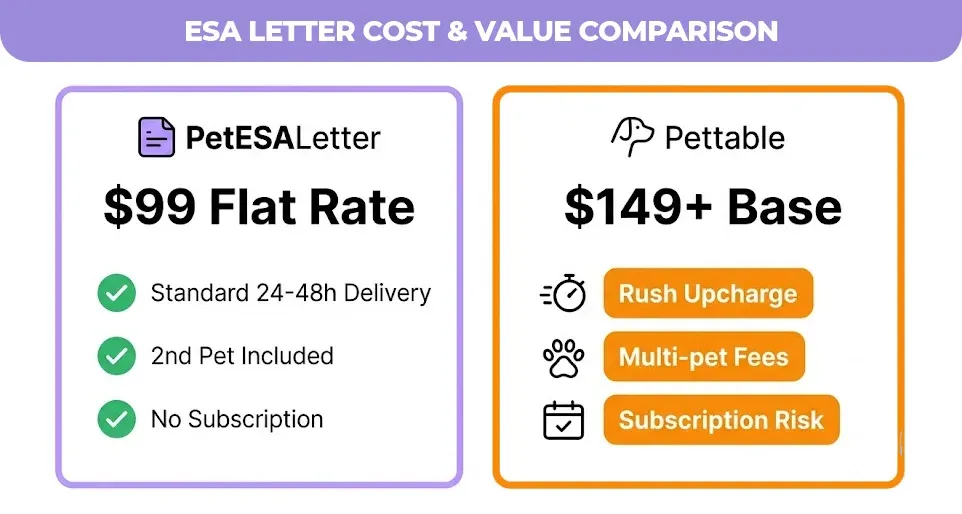
If you just want the short answer: Pettable’s housing ESA letter starts at $149 and can run higher with add-ons. PetESALetter charges a flat $99, with no upsells. Both connect you to a state-licensed therapist, both promise a signed letter within 24 to 48 hours of a completed consultation, and both offer a money-back guarantee if your letter gets rejected.
So the real question is not which one is legitimate. Both are. The real question is what you’re paying that extra $50 for, and whether it’s worth it for your situation. That’s what this guide breaks down line by line, with sources, so you’re not just taking a marketing page’s word for it.
One more thing before we get into it: this article was written by the team at PetESALetter. We’re comparing ourselves to a competitor, so treat every claim here the way you would treat any vendor comparison: check the sources, read the fine print, and make your own call. We’ve linked to Pettable’s own site, HUD, and independent review platforms throughout so you can verify everything yourself.
An ESA letter is a signed document written by a licensed mental health professional (LMHP) stating that you have a disability-related need for an emotional support animal. It’s the only document that gives you rights under the Fair Housing Act — not a registration, not an ID card, not a vest.
The provider matters because a landlord, HOA, or property manager can reject a letter that doesn’t meet basic standards: no license number, no state match, no evidence of an actual clinical evaluation. A $20 instant-download PDF from an unlicensed “counselor” isn’t protected under federal law. A letter from a real LMHP — whether it costs $99 or $149 — generally is, as long as the clinician actually evaluated you.
This is also why price isn’t the only variable. Two letters can both be “legitimate” and still differ in speed, renewal policy, and what happens if your landlord pushes back.
Pettable’s ESA housing letter starts at $149, with some bundles and expedited options pushing the total higher. That’s roughly 50% more than PetESALetter’s flat $99 rate for the same type of letter — a signed document from a state-licensed therapist that satisfies Fair Housing Act requirements.
Here’s the breakdown of what shows up at checkout:
| Item | Pettable | PetESALetter |
|---|---|---|
| Base housing ESA letter | $149 | $99 |
| Travel/general letter bundle | Additional cost, varies by promo | Included in scope of service |
| Rush/express processing | Extra fee for same-day | Standard 24–48 hr, no rush fee |
| Renewal (following year) | Separate charge | Separate charge |
| Second pet on same letter | Sometimes included in promos, sometimes not | Included, no extra fee |
Pettable frequently runs discount codes that bring the sticker price down closer to $99–$129, so what you pay in practice depends on whether you catch a promo. PetESALetter’s $99 is the standing price — no code needed, no tiers to compare.
If you’re comparing two letters that carry identical legal weight — both signed by a state-licensed LMHP, both FHA-compliant — the price difference is mostly the brand premium, marketing spend, and customer acquisition cost baked into Pettable’s higher price point. There isn’t a difference in how enforceable the letter is.
Both providers typically deliver a signed letter within 24 to 48 hours of your consultation being completed. Pettable’s fastest option, Express Service, comes at an extra cost. PetESALetter’s 24–48 hour window is the standard timeline, with no upcharge.
Turnaround time depends less on the brand and more on three things: how quickly you complete your intake form, how quickly a licensed clinician in your state is available for a live consultation, and whether your state requires an extended evaluation period (more on that below).
If you’re facing a hard deadline — a lease signing tomorrow, a landlord threatening a pet-fee charge this week — ask directly about same-day availability before you pay. Both companies advertise fast delivery, but “fast” depends on clinician scheduling in your specific state, not just the company’s marketing copy.
Both of these services use a two-step process: an online screening questionnaire followed by a consultation with a licensed mental health professional who decides whether you qualify. Neither service is a rubber stamp — a real clinician has to sign off, and either can decline to issue a letter if you don’t meet the criteria.
Here’s the step-by-step for both:
You complete a short online mental health screening (5–10 minutes).
A licensed clinician in your state reviews your answers.
You have a consultation by phone or video where the clinician evaluates whether an ESA is clinically appropriate for your situation.
If approved, the clinician issues a signed letter on official letterhead, usually within 24–48 hours.
If declined, a legitimate provider refunds you rather than charging for a letter you can’t use.
Why does the live consultation matter so much? Under HUD’s now-rescinded but still commonly cited 2020 guidance (see the legal update section below), a housing provider can request “reliable documentation” tying a disability to the need for an animal. A generic form filled out with no clinician involvement doesn’t create that link. A real evaluation, even a short telehealth one, does. This is the line between a legitimate ESA letter service and a scam site selling instant PDFs.
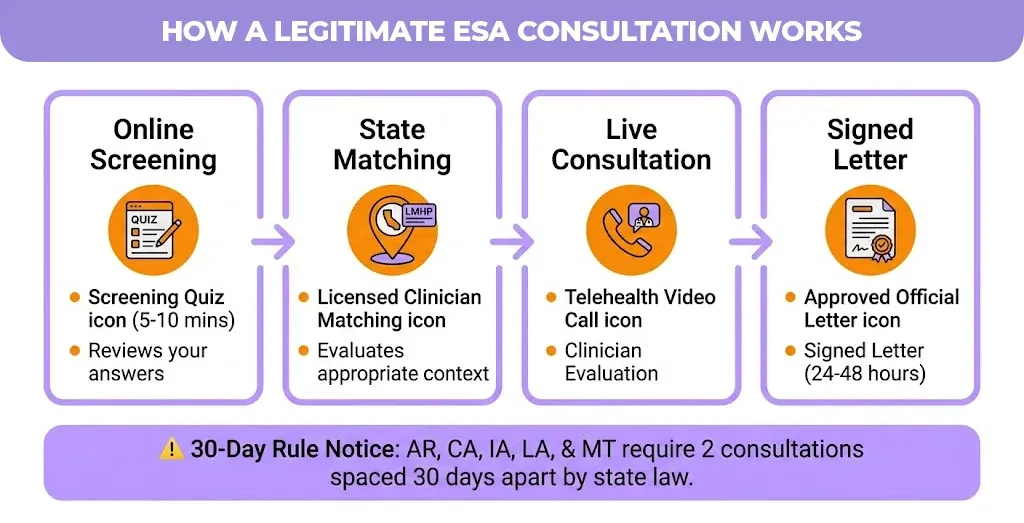
Arkansas, California, Iowa, Louisiana, and Montana have state laws requiring a client-provider relationship of at least 30 days before an LMHP can issue an ESA recommendation. In practice, this means residents of those five states go through two consultations spaced a month apart, regardless of which provider they use. If a service in any state promises a same-day letter with zero mention of this rule, that’s a red flag worth asking about directly. It may mean they’re not applying state-specific law correctly, or it may just mean they’re describing the letter as pending until the second session completes. Either way, ask.
Yes — Pettable is a real business connecting people to licensed clinicians, and it holds legitimate accreditation. But review scores for Pettable vary sharply by platform: strong on Trustpilot (commonly cited in the high 4-star range) and BBB (around 4.6/5, with BBB accreditation since 2023), but reviewers on other platforms have flagged specific complaints worth knowing about before you buy.
What shows up in independent, non-Pettable-owned reviews:
None of this means Pettable is a scam. It means it’s a real company with a real support queue, and like most companies that size, some orders go smoothly and some don’t. The takeaway: read recent reviews (not just the ones featured on the company’s own homepage) before you pay, for any provider.
PetESALetter is a smaller operation with a shorter public review history and a flat, no-subscription pricing model, which removes the recurring-charge complaint pattern by design — there’s only one line-item charge to begin with. We’d encourage you to check our own Trustpilot page the same way you’d check anyone else’s, rather than taking our word for it.
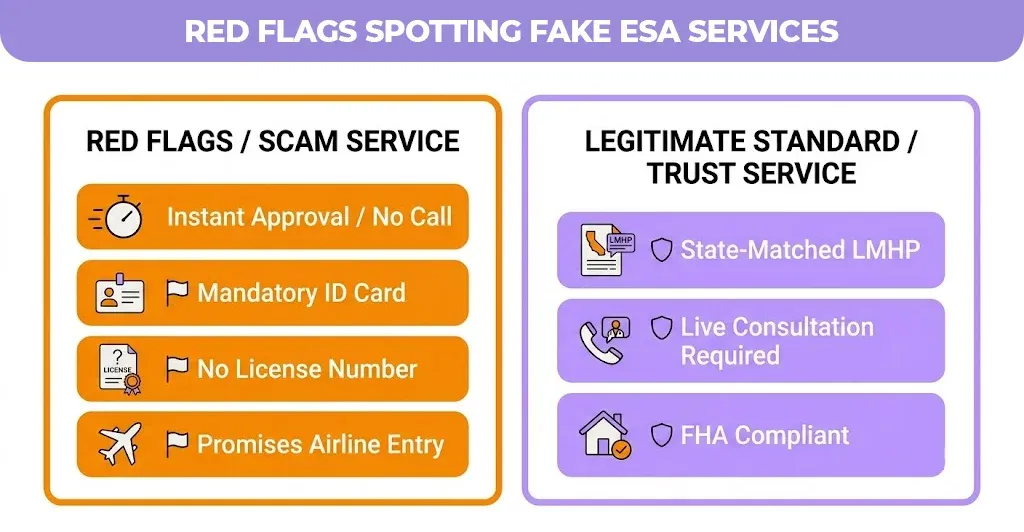
Both companies work with a network of state-licensed mental health professionals — LCSWs, LPCs, licensed psychologists, and other LMHPs — matched to your state of residence. This matters because an ESA letter is only enforceable if the person who signed it is licensed in the state where you live, not just licensed somewhere.
A landlord who wants to verify your letter is allowed to contact the licensing board or the clinician’s practice to confirm the license is real and current. This is one of the clearest ways to spot a fake ESA letter: if the “clinician” listed has no findable license number, or the license is registered in a different state than where you live, the letter can be legally challenged.
No license number printed on the letter
The clinician’s license state doesn’t match your state of residence
No consultation happened — you paid and received a letter with zero clinician contact
The letter promises airline accommodations (airlines no longer accept ESAs in the cabin as assistance animals)
The site advertises “instant” or “same-hour” approval with no screening questionnaire at all
A required national “ESA registry” is mentioned as if it’s mandatory — no such federal registry exists
The Fair Housing Act (FHA) requires housing providers to make a reasonable accommodation for a tenant who has a disability-related need for an assistance animal — even in buildings with no-pet policies, and without charging pet rent or pet deposits or applying breed or weight restrictions. This is enforced by HUD.
Here’s what that means in practice, broken into what landlords can and can’t do:
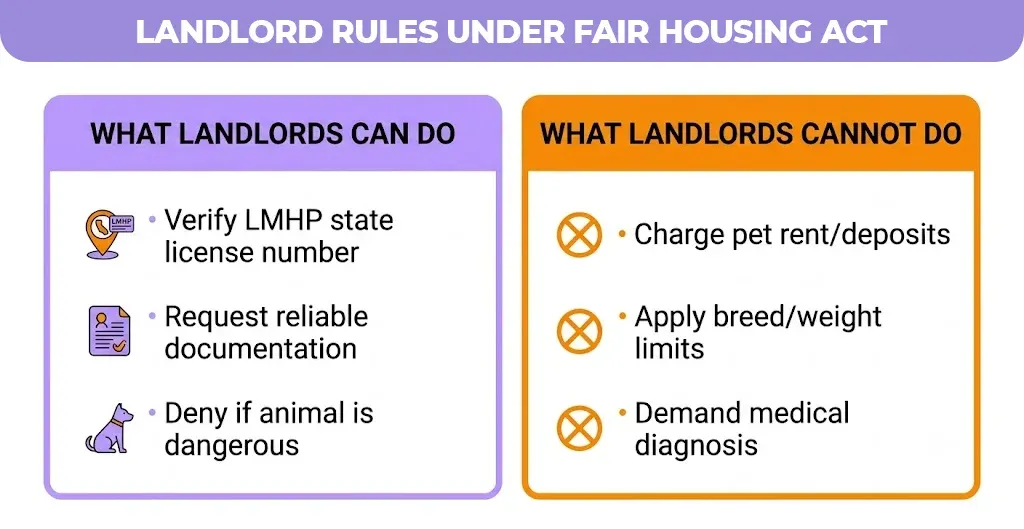
Ask for documentation of a disability-related need if the disability isn’t obvious (a signed ESA letter satisfies this)
Verify that the letter comes from a licensed professional
Deny a request if the specific animal poses a direct threat to others or would cause substantial physical damage that can’t be reduced by another accommodation
Ask that the animal not be a danger regardless of ESA status (an aggressive or dangerous animal is not automatically protected)
Charge a pet deposit, pet rent, or extra fee for an ESA
Enforce breed or weight restrictions against a qualifying ESA
Require the animal to be professionally trained or certified (ESAs, unlike psychiatric service animals, don’t require training)
Demand your specific diagnosis or medical records
Refuse simply because their policy says “no pets”
Landlords frequently confuse “no pets” with “no ESAs,” and treat an ESA letter like a pet application that can be denied at their discretion. It can’t be — a qualifying request under the FHA is a civil rights accommodation, not a lease amendment the landlord can approve or deny for any reason. When landlords get this wrong (usually out of unfamiliarity with the law rather than bad faith), it can become a formal fair housing complaint filed with HUD or a state housing agency.
This is the part most ESA comparison articles online are missing, and it matters.
On May 22, 2026, HUD permanently rescinded its 2020 guidance document, Notice FHEO-2020-01, which had been the go-to reference for how landlords should evaluate ESA letters and what documentation they could request. The underlying Fair Housing Act itself has not changed. But the detailed how-to guidance that both landlords and tenants relied on for six years is no longer active HUD guidance.
What this means practically:
Neither Pettable nor PetESALetter can change this fact for you — it’s a federal policy shift, not a vendor feature. But it’s worth knowing before you get into a dispute with a landlord who says, “Well, HUD doesn’t require that anymore.” The FHA still does; the detailed guidance on how to prove it is in flux.
Both companies offer a 100% money-back guarantee if your letter is rejected by a landlord or if you don’t qualify during the clinical evaluation. Read the specific conditions before you buy — “100% money-back” language can still come with a process you need to follow.
| Pettable | PetESALetter | |
|---|---|---|
| Refund if you don’t qualify | Yes | Yes |
| Refund if landlord rejects letter | Yes, per company policy | Yes, per company policy |
| Refund process | Contact support with denial documentation | Contact support with denial documentation |
| Subscription cancellation issues reported | Some reviewers report difficulty cancelling a recurring charge | Not applicable — single flat charge, no subscription |
The practical difference: a flat, one-time $99 charge with no subscription component means there’s nothing to accidentally forget to cancel. If a provider’s checkout includes any auto-renewal or membership toggle, read it before submitting payment, regardless of which company you choose.
Both services offer ongoing support if a landlord questions or challenges your letter, including help verifying the letter’s legitimacy. Pettable advertises a dedicated support team; PetESALetter offers 24/7 phone and email support at no extra charge.
This matters more than people expect going in. The moment a letter actually gets tested — a property manager calls asking if it’s real, or a leasing office says they’ve never seen the format before — is the moment support quality matters most. Ask any provider directly, before you pay, exactly what they do if your landlord contests the letter: Do they call the landlord? Do they provide a verification letter? Is there a live person to talk to, or just a support ticket queue?
Pros:
Established brand with a longer public track record and larger review volume
BBB-accredited since 2023
Strong Trustpilot and BBB scores
Live clinician consultations, including phone/video options
Covers all 50 states
Cons:
Higher price ($149+ vs. $99 flat)
Some reviewers report unexpected recurring subscription charges
Review scores vary significantly by platform
Express/rush delivery costs extra
Pros:
Flat $99 price, no upsells or hidden tiers
Same legal standard: state-licensed LMHP, FHA-compliant letter
No subscription — just a single charge, nothing to cancel
24/7 phone and email support at no added cost
Ongoing landlord verification support included
Cons:
Smaller company with a shorter public review history than Pettable
Fewer third-party review platforms to cross-check against
| Provider | Starting Price | Turnaround | Refund Policy | Subscription Risk |
|---|---|---|---|---|
| PetESALetter | $99 flat | 24–48 hrs | 100% money-back | None — one-time charge |
| Pettable | $149+ | 24 hrs–4 days depending on service level | 100% money-back per policy | Some reviewers report recurring charges |
| CertaPet | $149.99 | Up to 2 business days | Limited money-back | Varies |
| ESA Doctors | $159 | Not publicly stated | Qualify-only refund | Varies |
Want to know what you’re actually paying for? One flat fee, a real clinical evaluation, and a refund if it doesn’t work out. No renewal traps, no registry upsells.
Pettable is an online service that connects people with licensed mental health professionals for ESA evaluations. A legitimate ESA letter should come from a qualified professional after an appropriate consultation, rather than simply being purchased through a registration service. Pettable states that its clinicians conduct live consultations and issue letters if the person qualifies.
A landlord does not have to accept an ESA letter simply because it comes from Pettable. What matters is whether the letter meets applicable housing requirements and is issued by a properly licensed professional. Pettable says its letters can be verified by the issuing clinician and offers a money-back guarantee under certain conditions.
If your clinician approves your request, Pettable says the ESA letter is uploaded to your Pettable portal, where you can view and print it. The company also says ESA information can be accessed through its app.
Pettable’s current displayed pricing varies based on delivery speed and plan. Its current page shows $149 for delivery within 2–4 days and $199 for delivery within 24 hours, although promotional prices may be lower. Prices can change, so check the current Pettable checkout price before purchasing.

Licensed Psychotherapist
Darren is a leading expert in mental health advocacy and assistance animal documentation. He specializes in streamlining the process for obtaining ESA Letters, PSD Letters, and State-specific ESA compliance.

ESA Letters Issued

Successful Consultations

Licensed Therapist Network

Client Satisfaction Rate




Petesaletter.com helps you get your emotional support animal letter online with guidance and support.

Got Questions? Call us 24/7
Copyright © 2020-2026 Petesaletter All rights reserved. Terms | Privacy | Refund
Owned and Operated by Verimedix LLC