
Last Updated on: August 14, 2026
Reviewed by Darren Andrew Rafel
What is an emotional support cat letter? An emotional support cat letter is a signed document from a licensed mental health professional (LMHP) stating that your cat provides therapeutic benefit for a diagnosed mental health condition. It gives your cat legal housing protections under the Fair Housing Act — waiving pet fees, pet deposits, and breed or weight restrictions.
Yes — absolutely. The law does not restrict emotional support animals to dogs. Any domesticated animal can qualify as an ESA, including cats, as long as a licensed mental health professional determines the animal provides therapeutic benefit to the owner’s mental health.
Cats are actually one of the most common ESA species. Research published in the APA Monitor on Psychology supports the therapeutic value animals provide for conditions like anxiety, depression, and PTSD. Cats, in particular, offer consistent calming presence, routine, and tactile comfort — all of which matter when you’re managing a mental health condition day to day.
The one thing a cat cannot do is qualify as a service animal under the ADA. Service animals are specifically trained dogs (and sometimes miniature horses) that perform specific disability-related tasks. ESAs are different — they provide emotional support through companionship and do not require task-specific training. You can read more about this distinction in our guide on the difference between service dogs and emotional support animals.
An emotional support cat letter does one primary, powerful thing: it activates your Fair Housing Act (FHA) protections for housing.
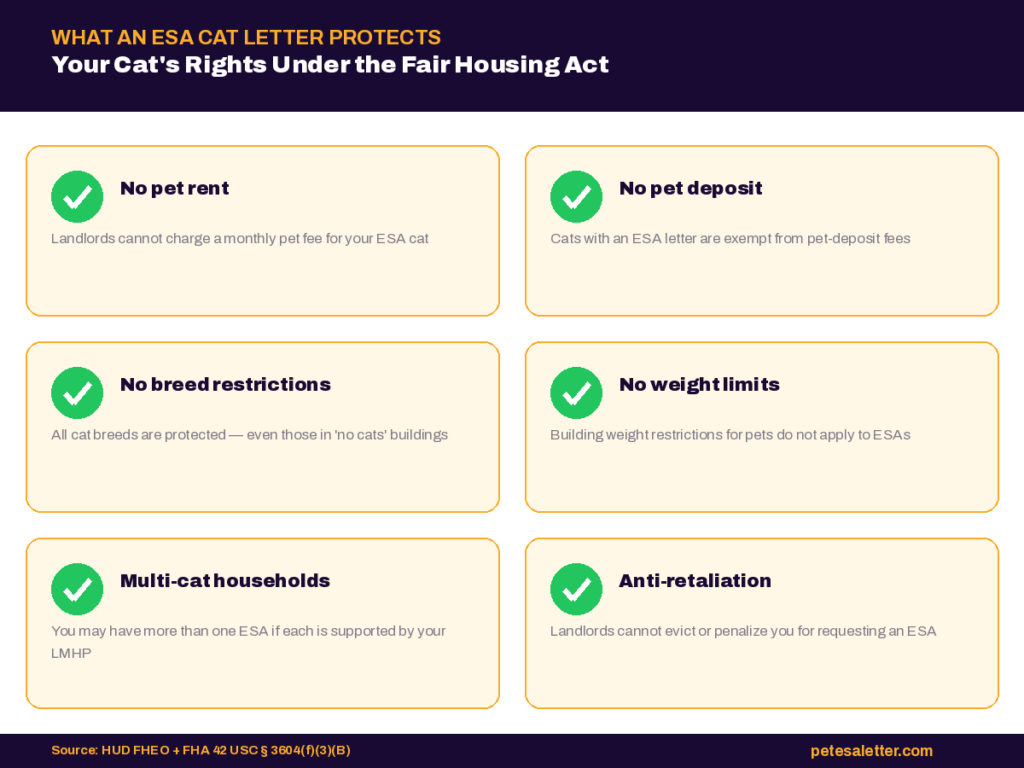
Under the FHA, as clarified by HUD’s guidance on assistance animals, landlords and housing providers must make reasonable accommodations for tenants with disabilities who have a documented need for an emotional support animal. For ESA cats, this means:
No pet rent. Your landlord cannot charge you monthly pet fees for your ESA cat.
No pet deposit. Security deposits specifically for pets are not permitted.
No breed or weight restrictions. Housing policies that ban large cats, certain coat types, or “exotic” domestic breeds do not apply to your ESA.
Access in no-pets buildings. Even if a lease or building policy says “no pets,” your ESA cat must be accommodated — with limited exceptions.
These protections apply whether you have a Maine Coon that weighs 18 pounds or a petite Siamese. The letter reframes your cat from a “pet” to a medically necessary accommodation in the eyes of housing law.
To understand the full scope of your housing rights, see our in-depth guide on the Fair Housing Act and emotional support animals.
Getting a legitimate ESA cat letter through PetESALetter is a straightforward three-step process. There’s no in-person visit required, and the entire process can be completed online.
3 steps to get an emotional support cat letter online in 24 hours.
Step 1 — Complete the intake form. Answer a brief assessment about your mental health history and how your cat supports your emotional well-being. This takes about five minutes and helps the licensed therapist understand your situation before the consultation.
Step 2 — Speak with a licensed mental health professional. You’ll be matched with a licensed therapist in your state who will conduct a brief telehealth consultation. This is an actual clinical evaluation — not a rubber stamp. The therapist determines whether you qualify based on your mental health needs.
Step 3 — Receive your ESA letter. If you qualify, your letter is delivered within 24 hours. It’s signed by your LMHP, includes their license number and state, and is written on official letterhead — everything a landlord needs to see.
For a deeper walkthrough of the process, visit our full guide on how to get an ESA letter.
PetESALetter charges $99 flat. That’s it. No upsells, no add-on packages, no separate housing letter vs. travel letter pricing tiers.
Here’s how that compares to the broader market:
| Provider | Starting Price | Housing Letter | Upsells? |
|---|---|---|---|
| PetESALetter | $99 | Included | None |
| Support Pets | $99 | $132 (separate) | Yes |
| Pettable | $119–$149 | Included | Moderate |
| Real ESA Letter | $149 | Included | Minimal |
| CertaPet | $149 | Included | Some |
| ESA Doctors | $159–$189 | Included | Some |
Some providers advertise low entry prices but require you to purchase separate “housing packages” or “combo letters” to get FHA-valid documentation. With PetESALetter, the $99 includes a fully FHA-compliant housing letter — no upgrades needed. And if you don’t qualify after the consultation, you get a full refund.
If cost is a primary concern, read our guide to finding a legitimate, affordable ESA letter without compromising on legal validity.
Yes. Under the Fair Housing Act, most housing providers are legally required to make reasonable accommodations for tenants with ESA letters. This applies to your cat the same way it applies to dogs.
HUD’s assistance animal guidance is explicit: housing providers may not refuse to accommodate an ESA simply because they have a no-pets policy or because they don’t personally like cats. A valid ESA letter shifts the legal framework — your cat is not a pet under the FHA; it is an accommodation.
When can a landlord deny your ESA cat? There are limited scenarios:
Your specific property is exempt from the FHA (e.g., owner-occupied buildings with four or fewer units, single-family homes rented without a broker)
Your cat poses a direct threat to the health or safety of others that cannot be reduced by another reasonable accommodation
Accommodating your cat would cause an undue financial or administrative burden — an extremely high bar most landlords cannot clear
A landlord cannot deny your ESA cat simply because of a blanket no-cats policy, because other tenants are allergic, or because the building has a weight limit. Blanket bans do not override the FHA.
If you’re preparing to notify your landlord, our guide on how to talk to your landlord about an ESA walks you through exactly what to say and what documentation to present.
This is the section where honesty matters most, so let’s be direct: ESA cats are not guaranteed cabin access on commercial flights.
In December 2020, the U.S. Department of Transportation updated its rules under the Air Carrier Access Act (ACAA). Airlines are no longer required to transport ESAs — they may now treat emotional support animals as regular pets. As a result, most major carriers stopped accepting ESAs in the cabin beginning in early 2021.
The DOT’s current ACAA guidance makes clear that only trained psychiatric service dogs retain guaranteed cabin access under federal air travel rules. ESA cats, rabbits, and other ESA species are subject to each airline’s individual pet policy.
What this means practically:
Your ESA cat may travel in-cabin as a regular pet if the airline allows small cats in-cabin (most do, with a fee)
In-cabin pet fees typically range from $95–$150 per flight segment
Your ESA letter has no legal effect on airline pet fees or cabin access under current federal rules
You can review which airlines still voluntarily accommodate ESAs at our post on which airlines allow emotional support animals. But the bottom line for 2026: if you plan to fly with your cat, check the airline’s pet policy directly and budget for standard pet travel fees.
Having an ESA letter protects your right to keep your cat. It does not, however, exempt you from all responsibility as a pet owner. Here’s what cat-specific ESA situations often involve:
Damage liability still applies. If your cat scratches hardwood floors or damages blinds, your landlord can deduct the cost from your standard security deposit. The FHA prevents pet-specific deposits, but it doesn’t waive your general responsibility for damages.
Litter box management. Some leases include reasonable rules about waste disposal that apply to all tenants. Reasonable hygiene requirements for ESA owners are generally upheld.
Declawing requests are not legally required. A landlord cannot condition your ESA accommodation on you agreeing to declaw your cat. Requiring a medical procedure as a condition of housing is not a “reasonable” accommodation request — it’s a violation of FHA principles.
No-cat buildings. These are still covered. If a building has a strict no-cat policy (for example, in a building where other residents have severe documented allergies), the landlord may attempt to deny the accommodation — but they must demonstrate that no reasonable alternative exists. A blanket no-cat policy alone is not sufficient grounds for denial.
If you’re in California, note that AB 468 adds additional state-level requirements for ESA letter legitimacy. See our California ESA letter guide for specifics.
While any cat can serve as an emotional support animal, certain breeds are particularly well-known for their calm, affectionate temperaments. If you’re choosing a cat specifically for emotional support — or just curious whether your cat’s breed makes a difference — here are five commonly recommended breeds.
Maine Coon — Often called “dog-like” for their loyalty and habit of following owners from room to room, Maine Coons are gentle giants that bond closely with their people.
Ragdoll — Named for their tendency to go limp when held, Ragdolls are exceptionally docile and thrive on physical closeness. They’re a top choice for people who find comfort in being touched or held.
Persian — Calm and low-energy, Persians are ideal for apartment living and people who prefer a quieter companion. They’re predictable and undemanding — grounding qualities for anxiety sufferers.
Russian Blue — Sensitive and loyal, Russian Blues tend to bond intensely with one person. They’re also one of the more hypoallergenic domestic breeds, making them a strong option for people with mild cat allergies.
American Shorthair — Easygoing, adaptable, and low-maintenance, American Shorthairs tolerate change well — which matters when housing situations shift.
For a full breakdown of cat breeds and ESA suitability, visit our dedicated guide on emotional support cats. If allergies are a concern for you or a housemate, see our list of the top 15 hypoallergenic cat breeds.
To qualify for an ESA cat letter, you need to have a diagnosed or diagnosable mental health condition that is meaningfully helped by the presence of your cat. You do not need a prior diagnosis in hand before starting the evaluation — the LMHP at PetESALetter can assess you as part of the consultation.
Conditions that commonly qualify include:
Generalized anxiety disorder — cats provide grounding, routine, and physical comfort that reduces anxious arousal
Major depressive disorder — the responsibility of caring for a cat and the cat’s companionship can counter isolation and low motivation
PTSD — cats can interrupt hypervigilance cycles and provide a consistent, safe presence
Panic disorder — having a cat present during high-anxiety periods is documented to reduce the intensity of panic responses
Social anxiety disorder, OCD, ADHD, and other conditions — evaluated on a case-by-case basis
The key is that your mental health condition must rise to the level of a disability — meaning it substantially limits one or more major life activities. The LMHP makes this determination during your evaluation. Read more about what licensed mental health professionals consider in our guide to LMHPs and ESA letters.
Ready to make it official for your cat? A licensed clinician evaluates your need and issues documentation that works for housing — no cat registry required.
Yes. There are no breed, age, size, or weight requirements for an ESA cat. The only requirement is that a licensed mental health professional establishes a therapeutic connection between your mental health condition and the cat’s presence. Your rescue cat qualifies just as well as a purebred.
No. There is no official government registry for emotional support animals. Websites that sell ESA “registration certificates,” ID tags, or vests are not providing legally recognized documents. The only document that carries legal weight is a properly written letter from a licensed mental health professional. Read our guide on what makes an ESA letter legitimate to avoid scams.
In most cases, no. Under the Fair Housing Act, landlords must accommodate ESA cats unless your housing falls into a narrow FHA exemption, or the cat poses a direct and documented threat to others. Blanket no-pet or no-cat policies do not override your ESA protections. The HUD FHEO guidance provides the full framework.
It can be — if it’s issued by an actual licensed mental health professional after a real clinical evaluation. The red flags that indicate a fraudulent letter include: no live consultation with the LMHP, instant letters without any assessment, therapists not licensed in your state, and letters issued by “registries” rather than individual clinicians. PetESALetter letters are signed by LMHPs licensed in all 50 states following a genuine telehealth evaluation.
Yes, in most cases. The Fair Housing Act requires housing providers to make reasonable accommodations for tenants with documented ESAs, even in buildings with strict no-pet policies. This applies to rental apartments, condos, and most other covered housing. Present your ESA letter to your landlord or property manager as a formal accommodation request.
Most ESA letters are valid for one year from the date of issue. Landlords may request updated documentation annually. PetESALetter issues letters with a clear issue date so you always know when renewal is due.
Get your FHA-compliant ESA cat letter from a licensed therapist in 24 hours. $99 flat — no upsells, no add-ons. 100% money-back guarantee if you don’t qualify. Get Your ESA Cat Letter at PetESALetter.com →

Licensed Psychotherapist
Darren is a leading expert in mental health advocacy and assistance animal documentation. He specializes in streamlining the process for obtaining ESA Letters, PSD Letters, and State-specific ESA compliance.

ESA Letters Issued

Successful Consultations

Licensed Therapist Network

Client Satisfaction Rate




Petesaletter.com helps you get your emotional support animal letter online with guidance and support.

Got Questions? Call us 24/7
Copyright © 2020-2026 Petesaletter All rights reserved. Terms | Privacy | Refund
Owned and Operated by Verimedix LLC