


ESA Letter in West Virginia: Housing Rights Under State Law
A West Virginia ESA letter is a $99 housing letter from a licensed clinician who evaluates you live. Clinically reviewed by Darren Rafel, LCSW.






ESA LETTER WEST VIRGINIA
What Is an ESA Letter in West Virginia?
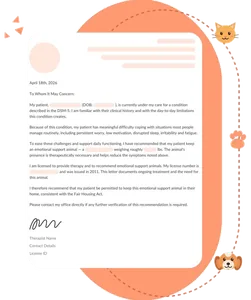
An ESA letter is a signed note from a licensed mental health clinician who has evaluated you. It is not a registration or ID card, and West Virginia keeps no official ESA registry.
You hand it to your landlord to request a reasonable accommodation under the federal Fair Housing Act and the West Virginia Fair Housing Act, W. Va. Code § 16B-18-1 et seq. SB 300 moved the state act there in 2024 from the repealed § 5-11A.
The letter states that you have a disability and that your emotional support animal eases its effects. The price is $99 flat.

How Do You Get an ESA in West Virginia?
Four steps take you from a free quiz to a clinician's decision. A letter is written only if that clinician finds a disability-related need.

Start With a Free Quiz
Answer private questions about your symptoms, daily life and animal. It takes about five minutes.

Pay $99, Then Meet Your Clinician
After checkout, a West Virginia-licensed clinician meets with you one-on-one by video, phone or secure online session.

The Clinician Decides
Not everyone qualifies. If the clinician finds you don't, you can request a full refund within 7 days.

Get Your Signed Letter
If you qualify, your letter usually arrives by email within 24–48 hours of the evaluation.
Who Qualifies for an Emotional Support Animal in WV?
You may qualify if a mental or emotional condition substantially limits a major life activity, the test in § 16B-18-3(g). A diagnosis alone does not settle it. Your clinician weighs how symptoms shape your day and how the animal helps.
West Virginia Emotional Support Animal Laws
West Virginia writes ESA protection into its own Fair Housing Act. A legislative rule, 71 CSR 9, effective February 5, 2025, repeats it. Neither one depends on HUD.
Training Is Not Required
Under W. Va. Code § 16B-18-3(p), a support animal qualifies with or without specific training if it gives emotional support and weighs less than 150 pounds.
The Citation Changed in 2024
SB 300 repealed the old housing citation, § 5-11A-5. Cite § 16B-18-5(f)(10) in a request today.
No Public Access Rights
The White Cane Law's access rights cover only individually trained service animals (§ 5-15-3(c)). An ESA has no right to enter stores or restaurants.
A Real Service-Animal Penalty
§ 5-15-9 is current law. Falsely calling an animal a service animal to gain public access is a misdemeanor.
No Expiry in State Law
No West Virginia statute or rule sets a letter validity period, a 30-day relationship or a license-number format.
Can a Landlord Deny an ESA in West Virginia?
Only on narrow grounds. Under § 16B-18-5(f)(10)(B), a landlord needs credible evidence that your animal poses a direct threat or would cause substantial damage that no other accommodation can fix. The landlord carries that burden (§ 16B-18-5(f)(9)).
Bend the No-Pets Rule
A no-pets policy generally has to give way for a qualifying assistance animal, since § 16B-18-5(f)(3)(B) requires reasonable accommodations.
No Pet Fee, Deposit or Rent
§ 16B-18-5(f)(10)(D) and 71 CSR 9-3.3 bar tying the accommodation to a fee, deposit, pet rent or other pet terms.
No Medical Records
A landlord may ask for a provider's documentation of your need, but not medical records, provider access or detailed diagnosis information.
Answer Without Undue Delay
Subsection (f)(10)(D) also bars unreasonably delayed responses, though it sets no fixed number of days.
Provide a Clinician's Letter
Give documentation from a professional treatment provider showing the animal offers emotional support (§ 16B-18-5(f)(10)(A)).
Pay for Real Damage
Under 71 CSR 9-3.5, you are liable for any damage your assistance animal causes.
Keep the Peace
The same rule makes you keep the animal from disturbing the property or your neighbors' quiet enjoyment.
TRAVEL & ACCESS
Flying, Stores and West Virginia Service Dog Laws
Airlines may treat an ESA as a pet. The Department of Transportation's Air Carrier Access Act rule ended special cabin rights on January 11, 2021.
Check your airline's pet policy for carrier size, fees and booking limits before you fly.
West Virginia service dog laws grant public access only to animals trained for a disability (§ 5-15-4). If your dog does psychiatric tasks, ask about our PSD letter. Moving away? Check the new state's rules.
Is There ESA Registration in West Virginia?
No. There is no ESA registry here, and a paid registration or ID card carries no legal weight. A clinician's letter plus fair housing law is what protects you. Some sites also claim the state repealed its Fair Housing Act in 2024. It did not; SB 300 renumbered it.
Myths and Facts:
WHY CHOOSE US
Why West Virginia Renters Choose PetESALetter
Licensed in West Virginia
A clinician licensed in West Virginia evaluates you, which fits the state's telehealth rule in § 30-1-26.
A Real Evaluation Every Time
No letter is signed without a one-on-one session, and the clinician alone decides whether you qualify.
Usually 24–48 Hours
If you qualify, your signed letter usually arrives one to two days after the evaluation.
Landlord Verification Help
Our support team answers your landlord's questions about your letter. West Virginia law sets no expiry date for it.
$99 Flat, Nothing Hidden
You pay $99 once, at checkout. No subscription, auto-renewal or add-on sale follows.
Real People on Support
Email support@petesaletter.com or call (470) 887-9106 to reach a person.
HIPAA-Conscious Privacy
We handle your health details with HIPAA-conscious care and never sell your data.
When You Get a Refund
If the clinician finds you don't qualify, request a full refund within 7 days. If your landlord rejects the letter, send support the written denial within 30 days for a refund.
TRUSTPILOT REVIEWS
What Clients Say on Trustpilot
Communication was great. The letter was processed quickly.
I had a great experience with PetesaLetter.com. The process was simple, fast, and easy to understand. The staff was helpful, and I appreciated how smooth everything went from start to finish. I would recommend them to anyone needing an ESA letter and looking for a convenient service.
FAQ
West Virginia ESA Letter FAQ
You need a disability and a provider's letter showing your animal gives emotional support. The animal must weigh under 150 pounds but needs no training or registration (§ 16B-18-3(p)).
No. State law bars tying the accommodation to a pet fee, pet deposit or pet rent (§ 16B-18-5(f)(10)(D); 71 CSR 9-3.3). You still pay for damage.
Only with credible, objective evidence about your own animal's conduct. Small-landlord exemptions are narrow: the single-house and small owner-occupied ones apply only to familial status (§ 16B-18-4(a)).
Not on its own. It is a clinician's statement of a disability-related need, and state law accepts it without medical records (§ 16B-18-5(f)(10)(A)).
With the West Virginia Human Rights Commission within one year (§ 16B-18-11), or in circuit court within two years (§ 16B-18-14). The Commission is HUD's FHAP agency.
No. Since May 22, 2026, HUD finds cause only for trained animals. That changed HUD's enforcement, not the Fair Housing Act or West Virginia's statute.
No. A landlord may ask for a provider's documentation. Calling an ESA a service animal in public can also be a misdemeanor under § 5-15-9.