


ESA Letter in Vermont From Licensed Mental Health Clinicians
An ESA letter in Vermont is a licensed clinician's signed finding that your emotional support animal eases a disability. It backs a housing accommodation under the Fair Housing Act and Vermont law, for $99 flat. Clinically reviewed by Darren Rafel, LCSW.






ESA LETTER VERMONT
What Is an Emotional Support Animal Letter in Vermont?
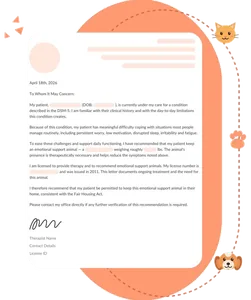
A clinician authorized to treat Vermont clients writes it after evaluating you one-on-one. There is no official ESA registry to join, here or in any other state. The letter itself is what a landlord may ask for when your disability or need is not obvious.
Sites selling ESA registrations, ID cards or vests offer nothing the law recognizes. A landlord cares who signed your letter, whether that person holds a valid license, and whether a real evaluation took place.
An emotional support animal letter Vermont landlords can verify costs $99 flat at PetESALetter, with no subscription or renewal charge. It covers your home only. It gives no rights in shops, restaurants or airplane cabins.

How Do You Get an ESA Letter in Vermont?
Four steps, all online, with a licensed clinician making the only decision that matters.

Take the Free Eligibility Quiz
Answer a short set of private questions about your mood, stress and daily routine. It takes about five minutes and helps you decide whether a full evaluation makes sense.

Meet a Clinician Authorized to Treat Vermont Clients
After checkout, a clinician allowed to practice in Vermont reviews your answers and meets you by video, phone or secure message, as 26 V.S.A. § 3053 requires.

The Clinician Makes the Call
Your clinician decides whether you have a disability and whether your animal helps with it. Not everyone qualifies. If the clinician finds you don't qualify, you get a full refund.

Get Your Signed Letter
If you qualify, your letter usually arrives within 24–48 hours as a PDF on professional letterhead. It shows the clinician's name, license type, license number, state and date.
Who Qualifies for an Emotional Support Animal in Vermont?
Vermont law defines disability as a physical or mental impairment that limits a major life activity (9 V.S.A. § 4501(2)). Unlike federal law, it leaves out the word "substantially." A licensed clinician, not the quiz, decides whether that fits you.
Clinicians often evaluate people living with conditions like:
Vermont ESA Laws: What Rules Protect Your Animal?
Vermont ESA laws rest on agency rules, not a statute. The Human Rights Commission (HRC) applies 9 V.S.A. § 4503(a)(9)–(10) through them, alongside the FHA (42 U.S.C. § 3604(f)(3)(B)).
HRC Rules Cover Untrained Emotional Support Animals
HRC Rule 1(a) defines an "assistance animal" to include one that provides emotional support. Rule 49 bars refusing one "whether or not" it had special training, unless a listed exception applies.
How HUD's May 2026 Memo Affects Vermont
HUD's enforcement office now finds cause only for trained animals, but the FHA itself is unchanged. HRC Rule 43 follows HUD guidance, so the HRC's stance is uncertain. Private lawsuits remain open.
Pet Deposits: What HRC Guidance Says
No Vermont statute bans ESA pet fees. HRC web guidance, based on a HUD notice withdrawn in 2025, says landlords cannot charge an assistance-animal pet deposit. Request a waiver as an accommodation.
Your Diagnosis Stays Private
HRC guidance says a landlord should not ask what your disability is and should not demand private medical records. Your letter confirms a disability and a related need without naming the condition.
What Can a Vermont Landlord Ask About Your ESA?
Only two things, when your need is not obvious: whether you have a disability, and whether the animal helps with it. A landlord may also require that a dog be licensed and vaccinated.
Can a Landlord Deny an ESA in Vermont?
Covered landlords generally have to consider and grant a reasonable accommodation. Exemptions are read narrowly (§ 4500(c)), and the owner-occupied exemption is smaller than the federal one.
Apartments and Rental Houses
Apartment complexes, rented houses and managed units all fall under § 4503, whatever the pet policy says.
Condominiums and Co-ops
Association pet rules are rules and policies, so you can request an accommodation from the board.
Public and Assisted Housing
Housing authorities and subsidized complexes are covered by the FHA and by Vermont's fair housing chapter.
Owner-Occupied Fourplexes
A four-unit building where the owner lives is still covered here, although federal law would exempt it.
Owner-Occupied Triplexes
A building with three or fewer units, where the owner or immediate family lives, is exempt from rental rules (§ 4504(2)).
Single-Family Home Owners
Vermont has no federal-style exemption for owners of a few single-family houses. Those rentals stay covered, broker or not.
Religious Organizations
Section 4504(5) allows limited preferences by religious organizations. Ask the HRC if you are unsure one applies.
AIR TRAVEL
Flying With an ESA After the 2021 DOT Rule
An ESA letter gives no right to a seat in the cabin. Since January 11, 2021, the DOT's Air Carrier Access Act rule lets airlines treat ESAs as pets.
Check your airline's pet policy, fees and carrier size before booking. If your dog is task-trained, a PSD letter is the right document.
In Vermont, stores and restaurants may admit an ESA only at their discretion (HRC Rule 1(a)). Your letter is a housing document.
Vermont Service Dog Laws and ESA Honesty
Vermont service dog laws give public access only to trained dogs and miniature horses (§ 4502(b); HRC Rules 1(k), 41). There is no misrepresentation offense, but honesty still protects your housing request.
What Vermont law actually says:
WHY CHOOSE US
Why Vermont Renters Choose PetESALetter
Clinicians Authorized in Vermont
Your clinician holds a Vermont license, a Vermont telehealth license or registration, or a valid compact privilege, as the state's telehealth law requires.
Letters Landlords Can Check
Every letter is on professional letterhead with the clinician's name, license type, license number, state and date. Our support team answers landlord verification questions.
Prompt, Careful Turnaround
If the clinician finds you qualify, your letter usually arrives within 24–48 hours after the evaluation. The clinician never rushes the decision to hit that window.
Private, HIPAA-Conscious Handling
We treat your health information with HIPAA-conscious care and never sell your data. Your letter confirms a need without describing your diagnosis, which matches HRC guidance.
Support From Real People
Questions before checkout, during your evaluation or after delivery go to support@petesaletter.com or (470) 887-9106. A person replies, and we can share the HRC's contact details if a landlord says no.
One Flat $99 Price
The $99 housing letter has no subscription, no auto-renewal and no upsells. You pay at checkout, and the eligibility quiz is the only free step.
Clear Refund Terms
Clinician finds you don't qualify: request a full refund within 7 days. Landlord rejects your letter: send support the written denial within 30 days for a refund.
Psychiatric Service Dog Letters
If your dog is individually trained to perform tasks for a psychiatric disability, our PSD letter may fit better. Vermont's public-access rules follow the ADA (§ 4500(a)).
REVIEWS
What Clients Say on Trustpilot
Carlos helped tremendously thru every step even when there were app issues. Fast contact from therapist- they kept the price reasonable and no up sales! … You actually spoke to a therapist during the process to ensure it wasn't being used just to get out of paying pet rent!
They got back to me right away, they asked me if the information was correct and if not they can change it on the letter and send it back. They were very helpful, and kind. I loved their service. They can send you an email or a text which I think was very helpful. And the pricing is very good with very thing it comes with
FAQs
Vermont ESA Letter Questions
Yes, in most rentals. HRC Rule 49 bars refusing an assistance animal whether or not it is trained, unless a listed exception applies. Owner-occupied buildings of three or fewer units are exempt.
A licensed clinician must find that you have a mental or emotional disability and that your animal eases its effects. The free quiz only screens.
Get the reason in writing. You can report it to the Vermont Human Rights Commission (802-828-2480) within one year, with a sworn, notarized complaint. You can also sue under § 4506 within six years (12 V.S.A. § 525); no HRC case is needed first.
No statute or rule bars it, but HRC guidance says no pet deposit for assistance animals, so ask for a waiver. Application fees are banned (§ 4456a), and refundable deposits must come back within 14 days (§ 4461).