


ESA Letter in Tennessee: $99 Emotional Support Animal Letters
Tennessee renters can get an ESA letter from a licensed clinician after a real evaluation, for $99 flat. No state registry exists. Clinically reviewed by Darren Rafel, LCSW.






ESA LETTER TENNESSEE
What Is an Emotional Support Animal Letter in Tennessee?
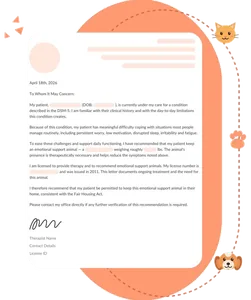
An ESA letter is a signed statement from a licensed mental health clinician. It confirms that you have a disability-related need and that your animal eases your symptoms.
The letter backs a housing request under the federal Fair Housing Act and Tenn. Code Ann. §§ 66-7-111 and 66-28-406, which cover “support animals” that provide emotional support.
Tennessee keeps no official ESA registry, and no website can add you to one. A clinician decides whether you qualify. Our price is $99 flat, with a full refund if you don't qualify.

How Do You Get an ESA Letter in Tennessee?
Four steps, all online and from home. The first step, a short eligibility quiz, is free.

Take the Free Eligibility Quiz
Tell us about your symptoms, your routine and the ways your animal helps you cope. The quiz takes about five minutes, and your answers stay private and go only to your clinician.

Talk With a Tennessee-Licensed Clinician
A mental health professional licensed in Tennessee meets with you one-on-one by video, phone or secure online visit. Tennessee's telehealth law, Tenn. Code Ann. § 63-1-155(g), generally requires that state license.

Your Letter, Usually Within 48 Hours
If you qualify, the clinician signs a letter on professional letterhead. It shows their name, license type, license number, state and the date. Most clients receive it by secure email within 24 to 48 hours.

Send It to Your Landlord
Give your landlord the letter with a short written request to waive the no-pet rule and any pet charges. Keep a copy, and write down the date you sent it.
Who Qualifies for an Emotional Support Animal in Tennessee?
Qualifying depends on how a mental health condition affects your days, not on how severe it looks to others. A licensed clinician evaluates your symptoms and decides whether an animal's presence eases them.
Common conditions in ESA evaluations:
Tennessee ESA Laws: What the Statutes Actually Say
Tennessee ESA laws add state rules to federal fair housing law. Two matching housing statutes cover support animals, and a criminal statute punishes false claims.
Two Statutes, One Rule
Tenn. Code Ann. § 66-7-111 applies statewide. Its twin, § 66-28-406, covers counties that topped 75,000 people in the 2010 census.
Pet Fees: Ask for a Waiver
No Tennessee law flatly bans ESA pet fees. The statutes let you request an exception to pet charges.
Verification Without Medical Records
Your landlord may verify your documentation but may not obtain confidential medical records (§ 66-7-111(d)).
Certificate Websites Don't Count
Since July 1, 2024, documents from sites that mainly sell certificates or registrations are not “reliable documentation.”
No Restaurants or Stores
Tenn. Code Ann. § 68-14-729, passed in 2024, keeps emotional support animals out of indoor restaurant areas. ESAs have no public-access rights; trained service animals do.
Can a Landlord Deny an ESA in Tennessee?
Landlords can deny an ESA in Tennessee only for specific reasons. The FHA, 42 U.S.C. § 3604(f)(3)(B), and the Tennessee Human Rights Act, § 4-21-601(b)(2)(B), treat refusing a needed, reasonable accommodation as discrimination.
No-Pet Policies Can Be Waived
A no-pet rule is a policy, and policies can bend for a disability. Once you hand over reliable documentation, your landlord generally has to consider the request in good faith, not just point to the lease.
Judged on the Animal, Not the Breed
Tennessee's support-animal statutes set no breed, size, weight or species limit. They cover an animal a healthcare provider recommends for emotional support. A breed ban limits pets, so you can ask for an exception to it too.
Small Landlords Are Covered More Often
The federal FHA exempts some owner-occupied buildings of up to four units and some single-family rentals. The Tennessee Human Rights Act exempts only owner-occupied two-unit buildings and single rooms (§ 4-21-602). The support-animal statutes have no small-landlord exemption.
When Denial Is Allowed
Under § 66-7-111(e), a landlord may deny the request if you fail to give accurate, reliable documentation after they ask. No statute sets a response deadline.
Ask Only About the Need
If your disability is obvious, the landlord may ask only about your need for the animal.
No Diagnosis Required
If it isn't apparent, they may request reliable documentation of the disability and the need.
No Retaliation
The Human Rights Act bars retaliation, such as eviction, for asserting your rights (§ 4-21-301).
AIR TRAVEL
Can Your ESA Fly in the Cabin?
Not as a legal right. Under the U.S. Department of Transportation's Air Carrier Access Act rule, in effect since January 11, 2021, airlines may treat an emotional support animal as a pet, with pet fees and carrier limits.
Every airline writes its own pet rules on size, carriers, health papers and booking windows. Trained service dogs, including psychiatric service dogs, fall under separate DOT rules.
Before you book any flight, read the airline's pet policy and get any approval in writing. Your ESA letter is a housing document and gives no cabin rights. Is your dog task-trained? Ask about our PSD letter.
Is There Emotional Support Animal Registration in Tennessee?
No. Emotional support animal registration does not exist in Tennessee, and there is no federal registry, ID card or certificate either. Tennessee law goes further and targets false claims. Here is what it says:
What Tennessee Law Says About Misuse:
WHY CHOOSE US
Why Choose PetESALetter for Your Tennessee ESA Letter?
Clinicians Licensed in Tennessee
Your clinician holds a Tennessee license, as the state's telehealth law expects. Landlords can look up the license number printed on your letter.
Tennessee Service Dog Laws vs. ESAs
Tennessee service dog laws, like § 62-7-112, admit trained dogs to public places. ESAs get no such access. Task-trained dog? Ask about our PSD letter.
Letters That Hold Up to Verification
When a landlord has verification questions, our support team answers them. Reach us at support@petesaletter.com or (470) 887-9106. Every letter reflects a real evaluation, and not everyone who applies qualifies.
Usually Ready in 24–48 Hours
Most letters arrive within 24 to 48 hours after the evaluation. Signing a lease soon? Start early, and give our support team your move-in date up front.
One Price: $99 Flat
The housing letter costs $99, with no subscription, auto-renewal or upsells. The eligibility quiz is free, and you get a full refund if a clinician finds you don't qualify.
Refunds With Clear Conditions
Don't qualify? You can request a full refund within 7 days. Landlord rejects the letter? Send support the written denial within 30 days for a refund.
Does an ESA Letter Expire?
Tennessee's statutes set no expiration date or renewal cycle, whatever some sites claim. A landlord may still prefer a letter written recently.
Private, HIPAA-Conscious Handling
Your answers go only to your clinician. We treat health information with HIPAA-conscious care and never sell it.
REVIEWS
Trustpilot Reviews From Our Clients
That it only took a day to get my esa letter and they stayed in contact the whole time
I had a great experience with PetesaLetter.com. The process was simple, fast, and easy to understand. The staff was helpful, and I appreciated how smooth everything went from start to finish. I would recommend them to anyone needing an ESA letter and looking for a convenient service.
FAQs
Tennessee ESA Questions, Answered
When you don't give accurate, reliable documentation after the landlord asks (§ 66-7-111(e)), or when an exemption applies. Otherwise, landlords generally have to grant the accommodation.
Many do, and the law allows it. Section 66-7-111(d) lets a landlord verify your documentation, such as the clinician's license, but not obtain confidential medical records.
See a licensed clinician who gains actual knowledge of your condition. Skip certificate and registration sites; Tennessee excludes them from reliable documentation.
Anxiety, depression, PTSD, panic disorder and OCD are common examples, but no diagnosis qualifies automatically. A licensed clinician decides whether your symptoms limit daily life and whether an animal helps.
HUD withdrew its 2013 and 2020 animal notices effective September 17, 2025. Its May 22, 2026, memo limits HUD's own cause findings to trained animals. The FHA, private lawsuits and Tennessee's statutes are unchanged.
With the Attorney General's Civil Rights Enforcement Division, within 180 days (§ 4-21-204(e)); call (615) 741-5825. The Human Rights Commission was dissolved July 1, 2025. You can also sue within one year (§ 4-21-311(d)).
The housing statute accepts a provider licensed “by the laws of any state” with actual knowledge of your disability. Telehealth care generally requires a Tennessee license (§ 63-1-155(g)), so our clinicians hold one.
Rarely, since a real evaluation takes a clinician's time. Ask your therapist first. Our letter costs $99 flat, with a full refund if a clinician finds you don't qualify.