


ESA Letter South Carolina: Emotional Support Animal Housing Letter
A South Carolina-licensed clinician evaluates you and, if you qualify, signs a $99 housing letter. No official registry exists. Clinically reviewed by Darren Rafel, LCSW.






ESA LETTER SOUTH CAROLINA
What Is an ESA Letter in South Carolina?
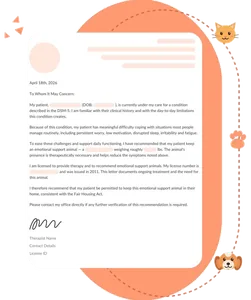
An ESA letter is a signed statement from a licensed clinician who has evaluated you. It backs a request to keep your emotional support animal despite a no-pet rule, under the Fair Housing Act and state law.Few states spell out ESA paperwork, but South Carolina does.S.C. Code § 31-21-70(N)lets a landlord ask two questions and request documentation. That paperwork is “deemed sufficient” if it shows a disability and that the animal gives “disability-related assistance or emotional support.”Lawmakers added this rule through S.281, signed as Act 44 of 2019. It sets no waiting period, session count, in-person visit or letter format. Licensing law still controls who may evaluate you.
The cost is $99 flat for the evaluation and, if you qualify, the letter. You pay at checkout; the quiz before it is free.
A letter supports your request; it does not force a yes. Landlords weigh each request, and some small landlords are exempt, as explained below.

How to Get an ESA Letter in South Carolina: Four Steps
The whole process runs online, from a free quiz to a clinician's decision. Here is what happens at each stage and when you pay.

Take the Free 5-Minute Quiz
Answer private questions about your symptoms, your routine and your animal. It shows whether a full evaluation makes sense.

Pay $99, Then Meet Your Clinician
You pay at checkout. A South Carolina-licensed clinician then evaluates you by video, phone or secure online visit.

Your Clinician Decides
Not everyone qualifies. If the clinician finds you don't, you can request a full refund within 7 days.

Get Your Signed Letter
If you qualify, your signed letter usually arrives by email within 24–48 hours after the evaluation.
Who Qualifies for an Emotional Support Animal in South Carolina?
You may qualify if a mental or emotional condition substantially limits a major life activity, such as sleep, work or self-care. State fair housing law calls this a “handicap” (§ 31-21-30(7)).
Licensed clinicians commonly evaluate conditions such as:
South Carolina ESA Laws: What § 31-21-70(N) Says
There is no ESA-titled statute here. Instead, the Fair Housing Law, S.C. Code §§ 31-21-10 to -150, names “emotional support” in one subsection. These cards show what that law does and does not do.
The Two Landlord Questions
A landlord may ask whether you have an impairment that substantially limits a major life activity, and whether you have a disability-related need for the animal.
Accommodation Duty, § 31-21-70(G)(2)
Refusing reasonable accommodations in rules, policies or practices counts as discrimination, so a no-pet rule does not end your request.
No State ESA Fee Ban
No South Carolina statute bars pet fees or deposits for an ESA. You can ask for a waiver as an accommodation; landlords decide case by case.
No Right to Public Access
Under § 47-3-990, places of public accommodation, from restaurants to airports, may set rules for nonservice animals, including emotional support animals.
What “Deemed Sufficient” Means
Under (N)(2), documentation is enough when it shows a disability and that the animal provides disability-related assistance or emotional support.
Is There Emotional Support Animal Registration in South Carolina?
No. No state agency keeps an ESA registry, and South Carolina law never asks for one. Online registrations, ID cards and vests carry no legal weight; a clinician's letter and § 31-21-70(N) do the work.
A Right to Ask
You can ask a covered landlord, in writing, to waive a no-pet rule as a reasonable accommodation for your disability.
Protection From Interference
Section 31-21-80 makes it unlawful to coerce, threaten or interfere with anyone using fair housing rights, including an accommodation request.
No Training Test
Subsection (N) covers “an animal that is not a service animal,” so state law sets no training requirement for an ESA.
Deposit Back in 30 Days
Itemized deductions are due within 30 days of move-out and your demand; wrongful withholding costs triple (§ 27-40-410).
Direct Threat or Damage
Section 31-21-70(K) excuses a landlord where occupancy would pose a “direct threat” to others' safety or “substantial physical damage” to their property.
Unreasonable or Unnecessary Requests
The accommodation has to be reasonable and necessary (§ 31-21-70(G)(2)). Paperwork showing neither disability nor need can fail.
Small-Landlord Exemptions
Owner-occupied buildings of four or fewer units, and some private owners of three or fewer houses, are exempt (§ 31-21-70(A)–(C)).
AIR TRAVEL
Do Airlines Accept ESAs From South Carolina?
Not as assistance animals. Under the DOT's Air Carrier Access Act rule, in force since January 11, 2021, airlines may treat an ESA as an ordinary pet.
Before You Book:
- Expect a pet fee
- Check carrier size limits
- Confirm advance-notice rules
Your letter covers housing only. If your dog is trained to perform psychiatric tasks, ask about our PSD letter instead.
South Carolina Service Dog Laws and the Misrepresentation Fine
Among South Carolina's service dog laws, the misrepresentation rule sits in S.C. Code § 47-3-980. It covers anyone who knowingly passes off an animal as a service animal to gain a disabled person's rights. A violation “does not constitute a criminal offense,” and no state statute creates an ESA offense.
What Can Happen:
WHY US
Why South Carolina Renters Choose PetESALetter
Letters Written to § 31-21-70(N)(2)
Each emotional support animal letter South Carolina clients receive addresses the statute's two points: your disability and the animal's disability-related support.
South Carolina-Licensed Clinicians
A clinician licensed in South Carolina evaluates you, as the state's telehealth licensing rules expect.
Letter Usually in 24–48 Hours
If you qualify, your signed letter usually reaches your inbox one to two days after the evaluation.
Fully Online
Take the quiz and meet your clinician from home, with nothing to mail.
$99 Flat, No Upsells
One payment at checkout. No subscription and no auto-renewal.
Refund Terms
Full refund if the clinician finds you don't qualify (request it within 7 days), or if your landlord rejects the letter (send the written denial within 30 days).
Landlord Verification Help
Our support team answers your landlord's questions about your letter.
HIPAA-Conscious Privacy
Your health details stay protected, and we never sell data.
REVIEWS
What Clients Say on Trustpilot
I had a great experience with PetesaLetter.com. The process was simple, fast, and easy to understand. The staff was helpful, and I appreciated how smooth everything went from start to finish. I would recommend them to anyone needing an ESA letter and looking for a convenient service.
FAQ
South Carolina ESA Letter FAQ
Get evaluated by a clinician licensed in South Carolina. If they find a disability-related need, they sign a letter for your landlord. Avoid any site that promises approval before an evaluation.
Many do, and state law lets them. Under § 31-21-70(N)(2), a landlord may request documentation to verify your answers, and paperwork showing disability and need is “deemed sufficient.”
Yes, in limited cases: a direct threat or substantial damage (§ 31-21-70(K)), a request that is not reasonable or necessary, or an exempt small landlord. A no-pet policy alone does not settle it.
Possibly. No South Carolina statute bans pet fees or deposits for an ESA, and HUD withdrew its no-fee guidance effective September 17, 2025. You can still ask for a waiver under § 31-21-70(G)(2).
Subsection (N) names no profession, but licensing law applies. The clinician needs a South Carolina license, a compact privilege, or, for out-of-state counselors and family therapists, a state behavioral telehealth registration (§ 40-75-800).
It is a clinician's professional statement, not a court ruling. In this state, a letter that establishes a disability and the animal's disability-related support meets the statute's documentation standard.
With a letter from a licensed clinician, not a vest, ID card or registry listing. An emotional support dog needs no special training to qualify under subsection (N).
A service animal is a dog or miniature horse trained to do tasks for a person with a disability (§ 47-3-920(4)). Emotional support is not a task, so an ESA has housing rights only.
With the S.C. Human Affairs Commission within 180 days (§ 31-21-120(B)), online or at 1-800-521-0725. Filing is free. You can also sue in state court within one year (§ 31-21-140(A)).
No. HUD's May 22, 2026 memo limits when HUD itself finds cause; the Fair Housing Act is unchanged. On August 5, 2026, the S.C. Human Affairs Commission said it keeps investigating ESA complaints regardless of training.