


ESA Letter Oregon: Housing Letters From Oregon-Licensed Clinicians
Get a $99 ESA letter in Oregon from a state-licensed clinician after a real evaluation. There is no ESA registry to join. Clinically reviewed by Darren Rafel, LCSW.






ESA LETTER OREGON
Oregon ESA Letter Requirements: What a Valid Letter Covers
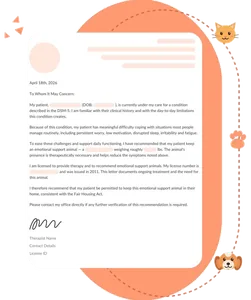
An emotional support animal letter in Oregon is a signed note from a licensed clinician who evaluated you. It confirms a disability and that your animal eases a related need.
You attach it to a reasonable accommodation request under the federal Fair Housing Act, 42 U.S.C. § 3604(f)(3)(B), and ORS 659A.145. Oregon ESA letter requirements are minimal: state law sets no format or renewal date.
A solid letter shows the clinician's name, license type and number, state and date. No official ESA registry exists, and online ID cards or certificates carry no legal weight.

How Do You Get an ESA in Oregon?
Getting an ESA in Oregon takes four online steps, from a free quiz to a clinician's decision. State law sets no 30-day waiting period or required second session.

Answer the Free Quiz
Spend about five minutes on private questions about your symptoms, daily life and animal. The quiz is free.

Pay and Meet Your Clinician
Pay $99 at checkout. An Oregon-licensed clinician then evaluates you by video, phone or secure online visit.

Get an Honest Decision
The clinician decides whether you qualify, and not everyone does. If you don't, request a full refund within 7 days.

Get Your Signed Letter
If you qualify, your letter usually arrives within 24–48 hours, on letterhead with the clinician's license details.
Who Qualifies for an Emotional Support Animal in Oregon?
Under ORS 659A.104, a disability is an impairment that substantially limits a major life activity. Oregon's list includes sleeping, socializing and even the ability to rent property. A licensed clinician decides whether an animal eases your symptoms.
Common conditions discussed in evaluations:
Oregon ESA Laws: What Protects Renters With an ESA?
HUD withdrew its old assistance-animal notices effective September 17, 2025. Its memo of May 22, 2026, limits HUD's own findings to trained animals. Oregon's protections are state law, and they use no training test.
No ESA-Specific Statute
No state law is written just for ESAs. Your rights come from fair housing law, a Bureau of Labor and Industries (BOLI) rule and tenant law.
The Accommodation Duty
ORS 659A.145(2)(g) bars refusing reasonable accommodations in rules, policies, practices or services that a disabled renter may need.
BOLI's Animal Rule
OAR 839-005-0220(2)(c) protects an animal that mitigates a disability-related need. It has no training test and bars deposits or other fees for that animal.
No Misrepresentation Crime
Oregon has no ESA or service-animal misrepresentation offense. Bills to create one, HB 2758 and HB 3098, died in 2019.
Your Letter Stays Private
Since June 5, 2026, HB 4123 bars landlords from disclosing disability records, such as your ESA letter, without your separate written consent, outside narrow exceptions.
Can an Oregon Landlord Deny an ESA?
Only on narrow grounds. ORS 659A.145 covers any rental and has no small-landlord exemption for disability. The federal Fair Housing Act, by contrast, exempts some owner-occupied buildings of up to four units (42 U.S.C. § 3603(b)).
No Pet Deposit
ORS 90.300(4) bars a pet security deposit for a companion animal that a tenant with a disability needs as an accommodation.
No Non-Refundable Pet Fees
ORS 90.302(1) bans non-refundable pet fees for every tenant. An unlawful fee can cost a landlord twice your damages or $300, whichever is greater.
Breed Is Not a Ground
To refuse your animal, a landlord needs reliable objective evidence that this specific animal poses a direct threat or risks substantial damage.
An Eviction Defense
If an eviction discriminates under ORS 659A.145, you have a defense unless you are behind on rent (ORS 90.390).
Bring an Honest Letter
Your letter should come from a clinician who actually evaluated you. A template or registry printout is not evidence.
Pay for Real Damage
You still owe for damage your animal causes. The regular security deposit can cover harm beyond ordinary wear and tear.
Clean Up After Your Animal
After a written warning, a landlord may charge a capped fee if you leave your animal's waste outside your unit.
PUBLIC ACCESS
Oregon Service Dog Laws, Flights and Public Places
Under Oregon service dog laws, only an animal individually trained to do work or tasks has public access (ORS 659A.143). An ESA has no right to enter stores, restaurants or offices.
Flights follow the same logic. Since January 11, 2021, the federal air travel rule has let airlines treat an ESA as a pet, so check carrier size, fees and booking limits before you fly.
Is your dog trained to perform tasks for a psychiatric disability? Then a PSD letter fits better than an ESA letter, and PetESALetter offers both.
Is There an ESA Registration in Oregon?
No. Oregon has no official ESA registry, ID card or certificate, and buying one adds no rights. What counts is an honest letter from a licensed clinician. Other claims online also miss the mark.
Four common myths, corrected:
No state law makes ESA misrepresentation a crime, so claims of a $10,000 fine are false.
No state statute or rule sets an expiration date for an ESA letter. Annual renewal is a sales policy, not law.
There is no 30-day, two-session or in-person rule for ESA letters here. Some other states have one.
That statute governs public places and requires a trained animal. Housing falls under ORS 659A.145 and BOLI's rule.
OUR STANDARDS
Why Oregon Renters Choose PetESALetter
Oregon-Licensed Clinicians
A clinician licensed to practice in Oregon evaluates you one-on-one by video, phone or secure online visit.
A Real Evaluation First
No letter goes out without a one-on-one evaluation, and only the clinician decides whether you qualify.
Usually 24–48 Hours
If you qualify, your signed letter usually arrives within 24–48 hours after the evaluation.
Landlord Verification Help
When your landlord has questions about your letter, our support team answers them so you don't have to.
$99 Flat, Paid Once
One $99 payment at checkout covers the evaluation and, if you qualify, the letter. No subscription or upsells.
Real People in Support
Reach our team at support@petesaletter.com or (470) 887-9106.
HIPAA-Conscious Privacy
We handle your health details with HIPAA-conscious care and never sell your data.
Refund Terms
If the clinician finds you don't qualify, request a full refund within 7 days. If your landlord rejects the letter, send us the written denial within 30 days.
REVIEWS
What Clients Say on Trustpilot
Carlos helped tremendously thru every step even when there were app issues. Fast contact from therapist- they kept the price reasonable and no up sales! … You actually spoke to a therapist during the process to ensure it wasn't being used just to get out of paying pet rent!
I had a great experience with PetesaLetter.com. The process was simple, fast, and easy to understand. The staff was helpful, and I appreciated how smooth everything went from start to finish. I would recommend them to anyone needing an ESA letter and looking for a convenient service.
OREGON FAQ
Oregon ESA Questions, Answered
See an Oregon-licensed clinician who evaluates you. The quiz is free and the evaluation costs $99, with a full refund if you don't qualify.
Only for narrow reasons, such as a specific animal's direct threat or substantial damage no accommodation can reduce. A request can also fail if your need isn't shown.
Many do, within limits. A landlord cannot require verification when your need is obvious and may otherwise ask only for necessary information (OAR 839-005-0220(2)(c)).
Yes, if they are licensed to treat you in Oregon and evaluate your need. State law does not list which professionals may write one.
Not for an animal you need because of a disability: deposits and other fees are barred. Pet rent is not expressly addressed, and you still pay for damage.
With BOLI (971-245-3844). Your signed complaint is due within one year; a questionnaire alone does not count. State court suits are due within two years (ORS 659A.875(3)).
No. State law sets no expiration date or renewal period. A landlord may ask only for information needed to evaluate your disability-related need.