


ESA Letter in North Dakota: State Law, Landlords and Your $99 Letter
A clinician licensed for North Dakota evaluates you and, if you qualify, writes your $99 housing letter. Clinically reviewed by Darren Rafel, LCSW.






ESA LETTER NORTH DAKOTA
What Is a North Dakota ESA Letter?
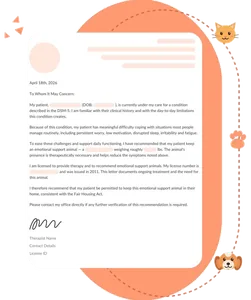
An ESA letter is a signed letter from a licensed clinician. It states that you have a disability and that your emotional support animal helps with it. There is no official registry, ID card or certificate.
You give it to a landlord when you ask for a reasonable accommodation under the Fair Housing Act and N.D.C.C. § 14-02.5-06(3)(b). PetESALetter charges $99 flat.
State law shapes the paperwork. N.D.C.C. § 47-16-07.5, created by HB 1191 in 2015 and amended in 2017, says when a landlord may ask for it and who may write it.

How to Get an ESA Letter in North Dakota
The state sets no waiting period, session count or in-person rule for these letters. Two 2025 bills tried to add a 30-day rule, and both failed. The process has four steps.

Take the Free Quiz
Answer a private five-minute quiz about your symptoms, your daily life and the role your animal plays.

Pay $99, Meet Your Clinician
Pay $99 at checkout. A clinician licensed for the state then holds a one-on-one evaluation by video, phone or secure online session.

The Clinician Decides
Your clinician alone decides whether you have a disability-related need for the animal. Not everyone qualifies.

Receive Your Letter
If you qualify, your letter usually arrives within 24–48 hours on letterhead with the clinician's name, license type, license number, state and date.
Who Qualifies for an Emotional Support Animal in North Dakota?
The state's housing law, N.D.C.C. § 14-02.5-01(6), defines disability as a mental or physical impairment that substantially limits at least one major life activity. You do not need an earlier diagnosis or a current therapist. A licensed clinician looks at how symptoms affect your sleep, work, focus or self-care, and whether the animal eases them.
North Dakota ESA Laws, Section by Section
North Dakota ESA laws are short. One leasing section covers paperwork, one punishes false claims, one limits deposits, and the housing discrimination act supplies the right to an accommodation.
HUD's 2026 Memo, in Context
HUD's May 22, 2026, memo says HUD will find cause only for trained animals. The Fair Housing Act is unchanged, private lawsuits remain open, and § 14-02.5-06(3)(b) has no training element.
Section 47-16-07.5 Explained
A landlord may require reliable documentation only in a no-pets rental, and not when your disability or need is readily apparent or already known.
Stores Can Say No
The state's service-animal law, § 25-13-01.1, covers trained dogs only. An ESA has no right to enter stores or restaurants.
No 30-Day or Renewal Rule
No state law sets a waiting period, session count or expiry date. SB 2193 failed in the House 12–81, and SB 2222 failed in the Senate 1–44.
Work Requests Are Separate
A housing letter does not settle a workplace request. Employment accommodations follow their own rules, so raise them with your employer separately.
Can North Dakota Landlords Refuse an ESA?
Sometimes. Landlords generally have to consider and grant a reasonable accommodation under § 14-02.5-06(3)(b). They may refuse if the animal poses a direct threat or would cause substantial physical damage (§ 14-02.5-06(6)), or if the request is not reasonable or necessary.
Paperwork Only in No-Pets Rentals
Section 47-16-07.5 lets a landlord demand paperwork only in a no-pets rental, and never when your need is readily apparent or already known.
No Pet Security Deposit
Section 47-16-07.1(2) bars a pet security deposit for a companion animal required as a reasonable accommodation. State law does not address pet rent or other fees.
What the Letter Must Confirm
Only two things: your disability, and how it relates to your need for the animal. The statute requires no diagnosis, license number or set form.
Small Landlords May Be Exempt
Owner-occupied buildings of up to four units, and owners of three or fewer single-family houses renting without a broker, may be exempt (§ 14-02.5-09).
Ask in Writing
Send your request and letter in writing, and keep copies. If refused, cite § 14-02.5-06(3)(b), § 47-16-07.5 and, for deposits, § 47-16-07.1(2).
Damage Is Still Yours
A security deposit may still cover damage your animal causes beyond normal wear and tear (§ 47-16-07.1(3)).
Safety Limits Apply
Keep your animal under control. A landlord may refuse an animal whose tenancy would pose a direct threat to others' health or safety.
TRAVEL AND PUBLIC PLACES
ESAs, Flights and North Dakota Service Dog Laws
Since the DOT's Air Carrier Access Act rule took effect on January 11, 2021, airlines may treat an ESA as a pet, with pet fees and carrier rules.
North Dakota service dog laws protect a dog trained to do work or perform tasks. That dog may enter public places without an extra charge (§ 25-13-02). An ESA is not covered.
If your dog is task-trained for a psychiatric disability, ask about our PSD letter instead. Never call an ESA a service dog, because that can be an infraction.
Fake ESA Claims: North Dakota Penalties
Both penalty sections punish knowing lies, not honest requests. No state statute punishes the sellers of false ESA letters; two 2025 bills to do that failed.
What misuse can cost you:
Online registries, ID cards and certificates carry no legal weight here. No state agency keeps a list of emotional support animals.
No ESA Registration in North Dakota: Do This Instead
Clinicians Licensed for North Dakota
Remote care for someone in North Dakota counts as practice there (§ 43-51-02). Your clinician holds a North Dakota license or a compact privilege.
A Real Evaluation, Not a Form
A clinician reviews your answers and talks with you before deciding. No outcome, from the clinician or a landlord, is promised in advance.
Usually Ready in 24–48 Hours
If you qualify, your signed letter usually arrives within 24–48 hours after the evaluation.
No Expiry Date in State Law
No state law puts an expiry date on your letter. SB 2222 (2025) would have done so, and it failed in the Senate.
$99 Flat, Paid at Checkout
No subscription, no auto-renewal, no upsells. Only the eligibility quiz is free.
Support From Real People
Email support@petesaletter.com or call (470) 887-9106. We answer landlord verification questions too.
HIPAA-Conscious Privacy
Your health details get HIPAA-conscious handling, and we never sell your data.
Fair Refunds
Full refund if the clinician finds you don't qualify (request within 7 days) or your landlord rejects the letter (send the written denial within 30 days).
REVIEWS
What Clients Say on Trustpilot
That it only took a day to get my esa letter and they stayed in contact the whole time
FAQ
North Dakota ESA Questions, Answered
Take the free quiz, pay $99 and meet a clinician licensed for the state. If you qualify, your letter usually follows within 24–48 hours.
They can. A no-pets landlord may request reliable documentation unless your need is apparent or already known (§ 47-16-07.5), and may check the clinician's license.
No. Section 47-16-07.5 points to a physician or medical professional, not the tenant.
Not under the housing statute. But remote care for someone in North Dakota is practice there (§ 43-51-02), so pick a state-licensed or compact-privileged clinician.
File with the Department of Labor and Human Rights within one year (§ 14-02.5-18), or sue in district court within two years (§ 14-02.5-39). Its stance on untrained ESAs since HUD's May 2026 memo is unannounced.
Only in narrow cases. Trained service dogs may enter public places (§ 25-13-02), and denial is a class A misdemeanor (§ 25-13-04). Federal ADA rules allow excluding a dog that is out of control or not housebroken. ESAs have no such right.