


ESA Letter in Maryland From a Licensed Clinician for $99
Maryland renters can ask to keep an emotional support animal under a no-pet lease. A licensed clinician evaluates you for $99 flat. Clinically reviewed by Darren Rafel, LCSW.






ESA LETTER MARYLAND
What Is an ESA Letter in Maryland, and What Does It Do?
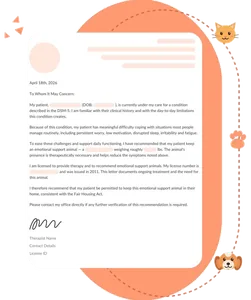
An emotional support animal letter in Maryland, or ESA letter, is a signed statement from a licensed mental health clinician. It backs a housing request under the Fair Housing Act and State Gov't § 20-706(b)(4). No official registry exists.
The letter says you have a disability and that your animal eases its effects. A registry ID, vest or certificate cannot do that job.
The evaluation and letter cost $99 flat, with no subscription. If a clinician finds you don't qualify, you get a full refund. Letters usually arrive within 24–48 hours after the evaluation.

How Do You Get an ESA in Maryland?
Everything happens online, and a clinician evaluates you before any letter is written. Getting an ESA in Maryland takes four steps. The first one, a short quiz, is free.

Take the Free Quiz
Tell us, in private, how your symptoms affect sleep, work or relationships, and how your animal helps. It takes about five minutes.

Talk With a Licensed Clinician
You then meet one-on-one with a mental health professional who holds a Maryland license, by video, phone or secure online visit.

The Clinical Review
The clinician asks about your history and symptoms, then decides whether an animal truly helps. This is a real assessment, and some people do not qualify.

Receive Your Letter
If you qualify, the clinician signs a letter on professional letterhead. Share it with your landlord along with a short written request, and keep a dated copy.
Who Qualifies for an Emotional Support Animal in Maryland?
You may qualify if a mental or emotional condition substantially limits a major life activity, such as sleeping, working or being around people. That mirrors Maryland's legal definition of disability (State Gov't § 20-701(b)). You don't need to own an animal yet. Clinicians often assess:
What Do Maryland ESA Laws Actually Say?
Maryland ESA laws start with one fact: there is no ESA statute. Your rights rest on a general accommodation clause, federal law and new state guidance.
Is There ESA Registration in Maryland?
No. Maryland keeps no ESA registry, and neither does the federal government. Sites selling emotional support animal registration, ID cards or vests sell products, not rights. State guidance says a collar, vest or tag alone is generally not enough.
Who Can Write Your Letter?
No ESA law names who may write one. But Maryland's telehealth law requires a clinician to be licensed or otherwise authorized in the state (Health Occ. § 1-1005), such as through PSYPACT for psychologists.
What Belongs in the Letter
Maryland's civil rights agency says documentation should show two things: that you have a disability and that the animal gives a therapeutic benefit. Our letters also list the clinician's name, license type and number, state and date. A downloaded template cannot do this.
What Your Landlord Must Do
Maryland law bars a landlord from refusing reasonable accommodations in rules and policies (State Gov't § 20-706(b)(4)). The state's guidance also expects a good-faith dialogue before any denial.
Maryland Service Dog Laws vs ESAs
Maryland service dog laws protect only dogs trained to do tasks. State Gov't § 20-706(a)(3) excludes dogs that give only emotional support, so an ESA has no public-access rights. Task-trained dog? Ask about our PSD letter.
Emotional Support Animal Rights in Maryland After HUD's Memo
In a May 22, 2026, memo, HUD said its own staff would find cause only for trained animals. The Fair Housing Act itself did not change, and private lawsuits remain open. On Sept. 8, 2026, the Maryland Commission on Civil Rights (MCCR) responded: untrained ESAs can still be a reasonable accommodation under state law. That guidance is an agency reading, not a statute.
No ESA Fees or Deposits
MCCR guidance says landlords may not charge fees, deposits or even a processing fee for an ESA. The Tenants' Bill of Rights attached to your lease says no extra deposit or application fee, too.
No Blanket or Breed-Only Denials
MCCR warns that a blanket refusal will very often break the law. Rejecting an animal solely for its breed or species is generally evidence of discrimination. Any denial should rest on this animal's behavior.
No Diagnosis or Medical Records
Landlords may not ask about your diagnosis or its severity, demand medical records or require an exam. They may ask about the animal's size and breed, and whether it is house-trained and under your control.
Small Buildings Still Covered
Unlike federal law, Maryland's owner-occupied exemption leaves out disability, so a live-in landlord must still consider your request. A narrow single-family exemption remains (§ 20-704).
A Direct Threat or Damage
This specific animal would threaten others' health or safety, or cause substantial physical damage, based on its own history, not fears about its breed (§ 20-703(5)).
Missing Documentation
You gave no documentation when asked, or the letter shows no bona fide clinical relationship with you. Telehealth alone doesn't make a letter unreliable.
A Genuine Undue Burden
Granting the request would cause a genuine, substantial financial or administrative burden. MCCR says a hypothetical cost is not enough.
FLYING WITH AN ESA
Does a Maryland ESA Letter Cover Air Travel?
No. Since January 11, 2021, the DOT's Air Carrier Access Act rule has let airlines handle an emotional support animal like any other pet, with the usual fees and carrier limits.
Airlines set their own rules on cabin space, health forms and booking. Read the carrier's pet policy first, and keep its answer in writing.
A trained psychiatric service dog follows different DOT rules. Your ESA letter is for housing, where Maryland protections still apply.
Is Faking an ESA a Crime in Maryland?
No. Maryland has no law that makes it a crime to fake an emotional support animal, or even a service animal. The state's animal penalties punish people who turn away a trained service animal, with fines up to $500 (Hum. Serv. § 7-705(e)). A false ESA claim still carries real risks.
Where the Real Risk Lies:
WHY CHOOSE US
Why Do Maryland Renters Choose PetESALetter?
Letters Written for Housing Requests
Each letter supports a housing accommodation request under the Fair Housing Act and Maryland law. It claims nothing about airlines or public access.
Maryland-Licensed Clinicians
Your evaluator holds a Maryland license, as the state's telehealth law expects. The license type and number appear on your letter for easy checking.
An Honest Clinical Review
No one buys a result here. A clinician decides after a one-on-one evaluation, and some people do not qualify.
Letters Usually in 24–48 Hours
After your evaluation, the signed letter usually lands in your inbox within 24 to 48 hours. Tell support if a lease deadline is close.
Help With Landlord Checks
Property managers sometimes call to confirm a letter is real. Our support team handles those verification questions for you.
$99, No Hidden Fees
One flat price, no subscription, no upsells. Not qualified? Request a refund within 7 days. Landlord says no? Send the written denial within 30 days for a refund.
Real People on Support
Questions before or after your evaluation? Email support@petesaletter.com or call (470) 887-9106, and a person on our team will reply.
Private by Design
We handle your health details with HIPAA-conscious care and never sell your data to advertisers or anyone else.
REVIEWS
Trustpilot Reviews From Our Clients
Omg these people are amazing just great!! They are sufficient friendly and they understand. Thank you
They got back to me right away, they asked me if the information was correct and if not they can change it on the letter and send it back. They were very helpful, and kind. I loved their service. They can send you an email or a text which I think was very helpful. And the pricing is very good with very thing it comes with
FAQs
Maryland ESA FAQs
Only in limited cases. A landlord may refuse if this animal poses a direct threat or serious damage risk, or if your documentation is unreliable. Otherwise, State Gov't § 20-706(b)(4) generally requires a reasonable accommodation.
Yes. A licensed physician (MD) can write one after evaluating you. If you mean Maryland, the clinician should be licensed or authorized here (Health Occ. § 1-1005).
They can. MCCR advises landlords to confirm the provider has a bona fide relationship with you. They may not demand medical records or your diagnosis.
Get evaluated by a licensed clinician, who decides whether you qualify. A legitimate letter shows their license number and state. Skip registry and ID-card sellers.
HUD changed enforcement, not the statute. Its May 22, 2026, memo limits HUD cause findings to trained animals. The Fair Housing Act is unchanged; MCCR says untrained ESAs can still qualify.
File with the Maryland Commission on Civil Rights within 1 year (State Gov't § 20-1021(a)(2)). Its online questionnaire is not a filed complaint, so start early. You may also sue within 2 years (§ 20-1035).