
Client Satisfaction Rate

Last Updated on: July 9, 2026
Reviewed by Darren Andrew Rafel
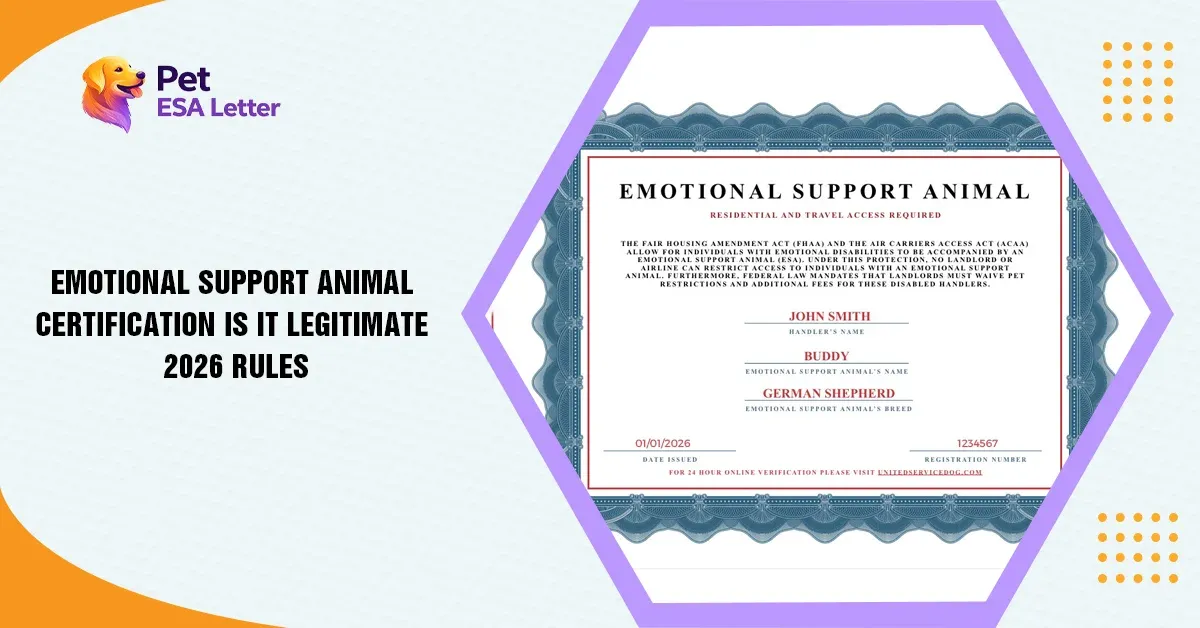
Search “emotional support animal certification” and you will find hundreds of websites promising an official certificate in five minutes flat. Yet every month, tenants holding those same certificates still face eviction notices, denied leases, and pet deposits landlords insist their emotional support animal should never have to pay. The gap between what these sites sell and what the law actually recognizes has only widened in 2026, after a sweeping federal policy change reshaped how housing providers evaluate ESA accommodation requests. This guide cuts through the confusion: what an ESA certification actually is, why the certificate model collapses under scrutiny, and exactly what documentation still holds up under the law today.
Is there a certification for emotional support animals? No. Neither federal law nor any U.S. state operates a government-approved emotional support animal certification or registration database. No certificate, ID card, vest, or online registry number carries legal weight. The only document that matters is an emotional support animal certification letter, an individualized written recommendation from a state-licensed healthcare or mental health practitioner, confirming a diagnosed condition that limits a major life activity and describing the animal’s therapeutic role. |
Terms like “emotional support animal certificate,” “certificate for emotional support animal,” and “animal emotional support certification” get searched hundreds of thousands of times a month, and an entire industry has grown up around selling them. The uncomfortable truth: none of it is legally recognized. There is no federal ESA registry, no accredited certification body, and no card, badge, or vest that any law requires a landlord to accept.
Worse, relying on one of these products can actively backfire. Corporate landlords and the automated property management screeners many of them now use are trained to instantly flag generic PDF templates purchased from commercial registry sites. Vests, ID badges, and registry numbers hold no legal standing whatsoever, and presenting one in place of real documentation is often treated as a red flag rather than proof of a legitimate need.

The document that actually carries weight is not a certificate at all, it is a letter. A legitimate emotional support animal certification letter is an individualized recommendation, printed on a licensed practitioner’s official letterhead, that includes an active and verifiable state license number. It is issued after real clinical contact, not generated by an automated quiz.

On May 22, 2026, the U.S. Department of Housing and Urban Development’s Office of Fair Housing and Equal Opportunity (FHEO), under Assistant Secretary Craig Trainor, issued an internal enforcement memorandum permanently rescinding its long-standing 2013 and 2020 guidance notices on assistance animals. For nearly two decades, those notices told landlords to treat any assistance animal, trained or untrained, as a required accommodation.
The new memo sets a much narrower federal threshold: going forward, FHEO will find reasonable cause in an animal accommodation complaint under the Fair Housing Act only when the animal has been individually trained to perform specific disability-related work or tasks effectively adopting the same training standard the Americans with Disabilities Act has long used for service animals. Untrained comfort animals, which is what the overwhelming majority of ESAs are, no longer trigger the same federal enforcement presumption.

 PetESALetter
Verified
PetESALetter
Verified
Protect your housing rights with a legitimate, doctor-signed ESA letter. No pet deposit or breed restrictions.
Important Context This is a change in federal enforcement priority, not a change in the underlying law. The Fair Housing Act itself has not been amended, ESAs have not been made illegal, and a valid ESA letter has not been invalidated. Many states maintain their own ESA protections that are unaffected by this memo, and tenants retain the right to sue in court regardless of whether HUD chooses to investigate. |
Because HUD dropped the federal presumption of accommodation for untrained comfort animals, landlords now hold unprecedented leverage in disputed cases. Submitting a template purchased from a known online certificate farm gives a property manager immediate grounds to deny the request outright, reclassify the animal as an ordinary pet, and apply standard pet fees or deposits. A legitimate, individualized certification letter is now more important than ever; it is often the only thing standing between a tenant and a denied accommodation.
Here is exactly how to get emotional support animal certification the right way, through proper medical channels:
The May 22, 2026 HUD policy shift raised the stakes for untrained comfort animals. Landlords now have the leverage to reject template forms that lack a genuine clinical foundation. At Petesaletter, we follow strict medical and legal standards—matching you with state-licensed mental health professionals for an active, verifiable recommendation letter that protects your home.

High-volume search terms like “free emotional support animal certification,” “free emotional support animal certificate,” and “cheap emotional support animal certification” point to a predictable pattern: bait-and-switch offers designed to collect user data or upsell a worthless PDF badge. No legitimate, state-licensed medical practitioner works for free, and none provides a blind signature without an actual clinical evaluation.
So how much is an emotional support animal certification, realistically? Legitimate validation involves the same kind of standard fees you would pay for any real medical care typically a copay or session fee for a proper telehealth or in-clinic evaluation.
Service | Typical Cost Range |
Live telehealth or in-person clinical evaluation | $100 – $200 |
“Instant” online certificate or registry package | Low upfront cost, but zero legal standing |
Letter renewal following an existing provider relationship | Often lower than the initial evaluation fee |
Feature | Legitimate ESA Letter | Online “Certificate” Package |
Issued by | State-licensed healthcare or mental health practitioner | Anonymous online form or automated system |
Basis | Real clinical evaluation and diagnosed condition | A short quiz or no assessment at all |
Legal standing | Recognized documentation under the Fair Housing Act | None holds no legal weight |
Format | Individualized letter on licensed letterhead | Generic PDF, ID card, vest, or registry number |
Landlord recognition | Accepted as valid supporting documentation | Routinely flagged and rejected |
Typical cost | $100 – $200 for a real evaluation | Often marketed as “free” or “cheap,” but worthless |
The era of relying on a generic online certificate to bypass property rules is officially over, and the historic 2026 federal policy updates have only raised the stakes. True protection for you and your emotional support animal depends entirely on genuine clinical medical documentation: a real evaluation, a real license number, and a real letter that a housing provider can verify. Skip the registry, skip the vest, and go straight to the source that actually holds up a licensed practitioner who knows your case.
Don't risk a landlord denial or a lease violation notice over a worthless registry badge. In 2026, automated property management screeners instantly flag generic PDF certificates. Protect your housing rights with an authentic, individualized document that satisfies every legal hurdle. Connect with a licensed clinician in your state through Petesaletter to start your compliant evaluation today.
Only if the provider platform coordinates a live, state-regulated interactive clinical consultation with a licensed mental health professional in your specific state. Document-only web shops that skip real evaluation are not legitimate, regardless of how official their paperwork looks.
You prove it by presenting a signed, active medical recommendation letter from your state-licensed physician or therapist. Vests and registry IDs hold no legal proof and are not required by, or recognized under, federal law.
There is no fee to “certify” an animal, because no such certification exists. Expect to pay standard medical consultation fees, typically ranging between $100 and $200, to cover a licensed clinician's diagnostic evaluation time.
It depends entirely on your medical reality. If you have a documented mental health condition that limits daily life functions, an honest conversation with a treating physician or therapist makes the process straightforward.
Ready to skip the registry traps and protect your animal the right way? Establish a legally compliant, clinical foundation for your accommodation request and bypass hidden pet fees with complete peace of mind.

Licensed Psychotherapist
Darren is a leading expert in mental health advocacy and assistance animal documentation. He specializes in streamlining the process for obtaining ESA Letters, PSD Letters, and State-specific ESA compliance.

ESA Letters Issued

Successful Consultations

Licensed Therapist Network

Client Satisfaction Rate




Petesaletter.com helps you get your emotional support animal letter online with guidance and support.

Got Questions? Call us 24/7






Copyright © 2020-2026 Petesaletter All rights reserved. Terms | Privacy | Refund
Owned and Operated by Verimedix LLC