


ESA Letter Connecticut: Licensed Evaluations, $99 Housing Letters
Keep your animal in your Connecticut rental with a $99 letter written after a one-on-one evaluation by a state-licensed clinician. Clinically reviewed by Darren Rafel, LCSW.






ESA LETTER CONNECTICUT
What Does an ESA Letter Do in Connecticut?
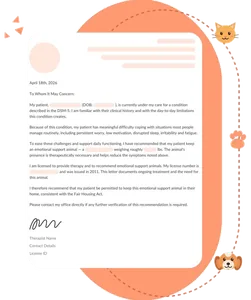
An ESA letter is a signed statement from a licensed mental health clinician, and no official registry exists. It confirms you have a mental or emotional disability that your animal helps ease. You give it to a landlord with a reasonable accommodation request.
Here, that request rests on the federal Fair Housing Act and C.G.S. § 46a-64c, the state fair housing law. Nothing else needs to be filed.
The letter costs $99 flat, paid at checkout. The eligibility quiz is free, and you get a full refund if the clinician finds you don't qualify.

How Do You Get an ESA Letter in CT?
Every step happens online. A licensed clinician, not a form, decides whether you qualify.

Take the Free Quiz
Spend about five minutes on private questions about your symptoms, your routine and the animal you lean on. Your clinician reads your answers before you talk.

Meet a Connecticut Clinician
Since July 2025, telehealth care for residents here calls for a Connecticut license or compact privilege. We pair you with a clinician who holds one.

Talk It Through
The session runs by video, phone or secure online visit, whichever your clinician uses. They ask how symptoms affect your sleep, work and home, then decide if an animal belongs in your care.

Receive Your Signed Letter
If you qualify, the letter usually reaches your inbox within 24–48 hours. It is printed on letterhead with your clinician's name, license number, state and the date.
Who Qualifies for an Emotional Support Animal in Connecticut?
Qualifying depends on your health, not on your pet's breed or training. A clinician looks for a mental or emotional condition that limits daily life and an animal that eases it.
A licensed clinician may evaluate conditions such as:
Connecticut ESA Laws: Which Rules Actually Protect You?
There is no ESA housing statute in Connecticut. Your rights come from the Fair Housing Act and a general accommodation clause in state law. Here is what each rule says, and what it leaves out.
No Standalone ESA Statute
The only statute that names ESAs is C.G.S. § 46a-64d, added by PA 24-18 in July 2024. It simply tells CHRO to post educational links. Your housing claim rests on § 46a-64c(a)(6)(C)(ii).
Pet Fees: No State Rule
No statute here bans or allows ESA pet fees, so you ask for a waiver as part of the accommodation. In state-financed SSHP housing, the DOH/CHFA manual (¶ 1-43(e)) bars fees and pet deposits.
Few Landlords Are Exempt
For disability claims, § 46a-64c(b)(1) exempts only rooms in an owner's own single-family home and a unit in an owner-occupied two-family building. Owner-occupied three- and four-family buildings stay covered.
Deposits Have a Legal Cap
C.G.S. § 47a-21 caps any deposit at two months' rent, or one month if you are 62 or older. It is generally due back within 21 days of move-out, or the landlord can owe double.
Telehealth Licensing Rules
C.G.S. § 19a-906 counts only Connecticut licensees as telehealth providers, since the out-of-state mental health allowance ended June 30, 2025. It is licensing law, not an ESA rule.
Can a Landlord Deny an ESA in Connecticut?
Landlords generally have to grant a reasonable accommodation unless an exception applies. Since HUD's May 22, 2026 memo, HUD finds cause only for trained animals, but the state clause has no training test, and private suits are unaffected.
Ask at Any Time
You can make the request before you sign a lease or years into one. Put it in writing and attach your letter.
Keep Your Diagnosis Private
Your letter shows a disability-related need without naming a diagnosis. State statutes set no list of allowed landlord questions, so federal fair housing rules fill that gap.
Protection From Retaliation
Section 46a-64c(a)(9) makes it unlawful to coerce, intimidate, threaten or interfere with anyone who uses fair housing rights, such as an accommodation request.
File Within 300 Days
A formal CHRO complaint is due within 300 days under C.G.S. § 46a-82(f)(2). Housing complaints need no notary. The online inquiry form does not stop that clock.
Go Straight to Court
You may skip CHRO and sue in Superior Court within one year of the denial, under C.G.S. § 46a-98a. No agency complaint comes first.
Denials for Real Risk
The DOH/CHFA manual for state-financed homes lists four denial grounds: direct threat, substantial damage, undue burden and a fundamental change to services.
Waiving Pet Rules
An approved accommodation lets your animal live in a no-pet unit. A pet fee waiver is something you request as part of it, not an automatic result.
BEYOND HOUSING
Emotional Support Dog or Service Dog? Connecticut Service Dog Laws
Air travel changed first. Under the Department of Transportation's Air Carrier Access Act rule, effective January 11, 2021, airlines may treat an emotional support dog or cat as a pet. Your letter gives no cabin rights, so check pet fees before booking.
State public access law leaves ESAs out too. Since PA 24-18 took effect on July 1, 2024, C.G.S. §§ 22-345, 46a-44 and 46a-64 use the ADA service-animal definition. It covers dogs trained to do tasks for any person with a disability.
Stores, restaurants, trains and rideshares may turn away an untrained ESA. Staff can ask whether the animal is needed for a disability and what task it was trained to perform. If your dog is task-trained, ask about our PSD letter.
Is There Emotional Support Animal Registration in CT?
No. The state keeps no ESA registry, ID card or certificate, and a paid listing proves nothing. A letter from a licensed clinician who evaluated you is what a landlord reviews.
What misuse really risks in Connecticut:
WHY PETESALETTER
Why Do Connecticut Renters Choose PetESALetter?
Connecticut-Licensed Clinicians
A mental health professional licensed in Connecticut runs every evaluation, in line with the state's telehealth licensing law.
Usually 24–48 Hours
Once your evaluation ends, a qualifying letter usually arrives within 24–48 hours. That helps when a lease signing or move-in date is close.
HIPAA-Conscious Handling
We treat your health details with care at every step, and we never sell your data.
Complete Clinician Details
Each emotional support animal letter Connecticut clients get from us lists the clinician's name, license type and number, state and date.
Real People on Support
Email support@petesaletter.com or call (470) 887-9106 before, during or after your evaluation. A person replies, not a bot.
Landlord Verification Help
If a property manager wants to confirm your letter is genuine, our team answers those verification questions directly, so you are not stuck in the middle.
$99 Flat, No Upsells
You pay $99 once at checkout, with no subscription. Full refund within 7 days if the clinician finds you don't qualify, or within 30 days of a landlord's written denial.
Fully Online Process
From a New Haven apartment to a Stamford condo or a quiet town rental, you finish the quiz, evaluation and letter from home.
REVIEWS
What Clients Say on Trustpilot
“The service was excellent! From the time I submitted the questionnaire to when I received my letter, it was less then 24 hours! Carlos and Darren were super kind and professional, and answered my questions super quickly. Definitely recommend!”
FAQs
Connecticut ESA Questions, Answered
Only for a lawful reason, like a direct threat or substantial damage. Rooms in an owner's own home and owner-occupied two-family buildings are exempt (§ 46a-64c(b)(1)).
Many do. A landlord may check the clinician's license and confirm the letter is genuine. Our team answers those questions.
No training or registration is involved. A licensed clinician evaluates you and, if the dog eases a qualifying condition, writes your letter.
State law is silent, so you request a fee waiver as part of your accommodation. State-financed SSHP housing bars ESA fees by policy.
No state law sets an expiration date. Some landlords prefer a recent letter, so update it if your situation changes.
You have 300 days to file with CHRO, or one year to sue in Superior Court. CHRO's housing unit answers at 860-541-3403.
No. § 46a-64d only has CHRO post education links. From October 1, 2026, PA 26-77 makes a § 46a-64c violation the class D misdemeanor “hate crime by discriminatory housing practice.”