

ESA Letter in Arizona From a Licensed Clinician
An ESA letter in Arizona comes from a licensed clinician who evaluates you. It costs $99 flat, with no registry. Clinically reviewed by Darren Rafel, LCSW.






ESA LETTER ARIZONA
What Is an Emotional Support Animal Letter in Arizona?
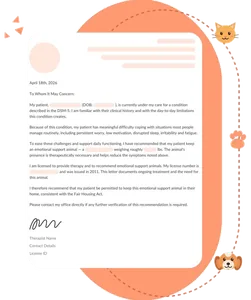
An ESA letter in Arizona is a signed statement from a licensed mental health clinician who has evaluated you. It says you have a disability and that an animal helps with it. Your landlord weighs it as part of a reasonable accommodation request.
Two laws back that request: the federal Fair Housing Act and the Arizona Fair Housing Act, A.R.S. § 41-1491.19(E)(2). Since September 26, 2025, the state act also defines an assistance animal as a "trained or untrained" animal that can provide "therapeutic or emotional support."
Under state law, youremotional support animal letterhas no set form, length or waiting period, because the state has no ESA documentation statute. At PetESALetter, a clinician licensed in Arizona, or one who meets the state's telehealth rules, evaluates you first. The letter then reflects a real clinical judgment.


How Do You Get an ESA Letter in Arizona? Four Steps
Everything happens online. You pay $99 at checkout, and then a licensed clinician evaluates you.

Take the Free Quiz
Spend about five minutes on private questions about your symptoms, home and animal. The quiz is free.

Meet Your Clinician
After checkout, a clinician who can treat people located in Arizona meets you by video or phone.

The Clinician Decides
Your clinician decides whether you qualify. Not everyone does. If you don't, you can request a full refund within 7 days.

Get Your Signed Letter
If you qualify, your letter usually arrives within 24–48 hours, showing the clinician's license number, state and date.
Who Qualifies for an Emotional Support Animal in Arizona?
You may qualify if a mental or emotional condition substantially limits a major life activity, the disability test in A.R.S. § 41-1491(6), and an animal eases your symptoms.
Arizona ESA Laws: What the Statutes Actually Say
Arizona has no ESA documentation statute. Renters rely on the state Fair Housing Act, as amended in 2025, plus federal law.
The Accommodation Duty in § 41-1491.19(E)(2)
Refusing a reasonable accommodation that may be necessary for equal use and enjoyment of a dwelling counts as discrimination under state law.
HB 2068 Names Emotional Support
Laws 2025, Ch. 191, effective September 26, 2025, defines an assistance animal as trained or untrained, including emotional support.
Landlord Immunity Under § 41-1491.38
A landlord is not liable for injuries or damages caused by an assistance animal it allows, so expect that risk to sit with you.
No Letter-Content, Waiting-Period or Renewal Rules
A proposed documentation checklist (§ 33-1320) was struck before HB 2068 passed. The state sets no relationship length, letter format or expiration date.
Fines Cover Service Animals Only
The only misrepresentation penalty, a civil fine up to $250, covers faking a service animal at a public place (§ 11-1024(K)).
Emotional Support Animal Rights in Arizona: Can a Landlord Say No?
A landlord covered by the Arizona Fair Housing Act generally has to consider and grant a reasonable accommodation unless a recognized exception applies. HUD's May 2026 memo changed federal enforcement, not these statutes.
An Exception to a No-Pet Rule
Put your request in writing. A covered landlord generally has to waive a no-pet policy when the request is reasonable.
Pet Fee Waivers: Guidance, Not Statute
No state statute bars ESA pet fees. The Attorney General's guide says landlords should not charge them for assistance animals.
The 1.5-Month Deposit Cap
Any refundable pet deposit counts toward the limit of one and a half months' rent in total security (§ 33-1321(A)).
Breed Limits: The AG's View
The AG's guide says a landlord may not deny an assistance animal because of stereotypes about breeds.
A Direct Threat or Damage
A landlord may refuse a specific animal that is a direct threat to others or would cause substantial physical damage (§ 41-1491.19(C)).
Exempt Small Landlords
Owners of three or fewer houses renting without an agent, and owners living in a building of four or fewer units, are exempt (§ 41-1491.02).
Undue Burden
AG guidance also allows a denial when a request would cause an undue financial and administrative burden or a fundamental alteration.
FLYING & PUBLIC PLACES
Flights, Stores and Arizona Service Dog Laws
Airlines may treat an emotional support animal as a pet. The Department of Transportation's Air Carrier Access Act rule, in force since January 11, 2021, ended ESA cabin rights, so your letter does not cover flights.
Before you book, read your airline's pet policy. Expect a pet fee, carrier size limits and caps on animals per cabin, and ask which health or vaccine records it wants.
On the ground, Arizona service dog laws protect only dogs or miniature horses trained to do work or tasks (A.R.S. § 11-1024). The statute says emotional support is not "work or tasks," so stores and restaurants may refuse an ESA. If your dog is task-trained, ask about our PSD letter.
Is ESA Registration in Arizona Real?
No. Emotional support animal registration in Arizona does not exist. No registry, ID card or certificate carries legal weight, and the state has no ESA misrepresentation offense in housing.
Common online claims, checked against the law:
WHY CHOOSE US
What You Get With PetESALetter in Arizona
Arizona-Licensed Clinicians
A clinician licensed in Arizona, or eligible under A.R.S. § 36-3606, evaluates you under the state's standard of care.
Letters Grounded in Housing Law
Each letter supports a reasonable accommodation request under federal and state fair housing law.
Usually 24–48 Hours
If you qualify, your letter usually arrives one to two days after the evaluation.
Fully Online
Take the quiz and meet your clinician by video or phone without leaving home.
$99 Flat, Nothing Hidden
One $99 payment at checkout. No subscription, auto-renewal or upsell.
Full Refund If You Don't Qualify
If the clinician finds you don't qualify, you can request a full refund within 7 days; if your landlord rejects the letter, contact support within 30 days with the written denial for a refund.
Landlord Verification Help
Our support team answers your landlord's questions about your letter.
Private and HIPAA-Conscious
Your health information gets HIPAA-conscious handling, and we never sell your data.
REVIEWS
What Clients Say on Trustpilot
Wonderful Experience. I got my letter within 24 hours after I spoke with a licensed therapist in my State. Would definitely recommend.
FAQ
Arizona ESA Letter FAQs: Landlords, Fees and the Law
Take PetESALetter's free 5-minute quiz, then pay $99 at checkout. A clinician who can lawfully treat you in Arizona evaluates you one-on-one by video or phone. If the clinician finds a disability-related need, you get a signed letter. If not, you can request a full refund within 7 days.
Yes, but only on recognized grounds. A covered landlord may refuse an animal that is a direct threat or would cause substantial physical damage, or a request that creates an undue burden. Small landlords exempt under § 41-1491.02 fall outside the state duty.
Many do. When a disability is not obvious, AG guidance lets a landlord ask for reliable disability-related information. State law has no verification checklist, and our support team answers landlord verification questions.
You need a condition that substantially limits a major life activity, the ADA-based test in § 41-1491(6), plus an animal that helps with it. A licensed clinician decides after evaluating you, and not everyone qualifies.
Arizona sets no letter format, so the real question is reliability. Red flags include no genuine evaluation, no license number, a clinician not licensed for your state, or a registry certificate in place of a letter. A landlord may question paperwork that does not show a disability and a disability-related need.
A psychiatric service dog must be individually trained to do work or tasks for your disability, as A.R.S. § 11-1024 describes. An ESA needs no training at all. If your dog is already task-trained, ask PetESALetter about aPSD letterinstead.
State law names no specific profession. At PetESALetter, a clinician licensed in Arizona, or one practicing under § 36-3606 or a licensing compact, evaluates you and signs the letter with their name, license type, license number, state and date.
HB 2068 took effect September 26, 2025, adding the assistance animal definition and landlord immunity. HUD withdrew its 2013 and 2020 animal notices, effective September 17, 2025. Its May 22, 2026 memo limits HUD cause findings to trained animals but leaves the FHA and private lawsuits intact. No new ESA law passed in 2026.
Arizona has no waiting period or 30-day rule. With PetESALetter, your letter usually arrives within 24–48 hours after the evaluation if the clinician finds you qualify. The evaluation still follows the state's standard of care.
No statute settles this, so it turns on your accommodation request. Here is where things stand:
- No statute bans ESA fees
- AG guidance opposes fees
- Request a waiver in writing
- Deposits capped at 1.5 months
- Unlabeled fees are refundable
State law sets no expiration date, and no federal rule does either. Some landlords ask for recent documentation at lease renewal, so read your lease. A fresh evaluation is a clinical choice, not a legal deadline.
File with the Attorney General's Civil Rights Division within one year (§ 41-1491.22(C)), or sue in superior court within two years, with no AG filing needed (§ 41-1491.31).
The letter from PetESALetter is $99 flat, with no subscription. The animal's own costs, such as food, vet care and supplies, vary widely by species and size, so budget before you adopt. Also plan for housing costs that a letter may not erase.
Landlord-tenant law caps all refundable security, pet deposits included, at 1.5 months' rent. After move-out, demand your deposit in writing; the itemized list is due within 14 business days.
Because § 41-1491.38 shields landlords from your animal's damage, renter's liability insurance that covers the animal is a sensible cost.
No. Businesses may refuse an ESA, because state law says emotional support is not "work or tasks" (§ 11-1024(A)). Calling one a service animal risks a $250 civil penalty.