Client Satisfaction Rate

Last Updated on: August 14, 2026
Reviewed by Darren Andrew Rafel
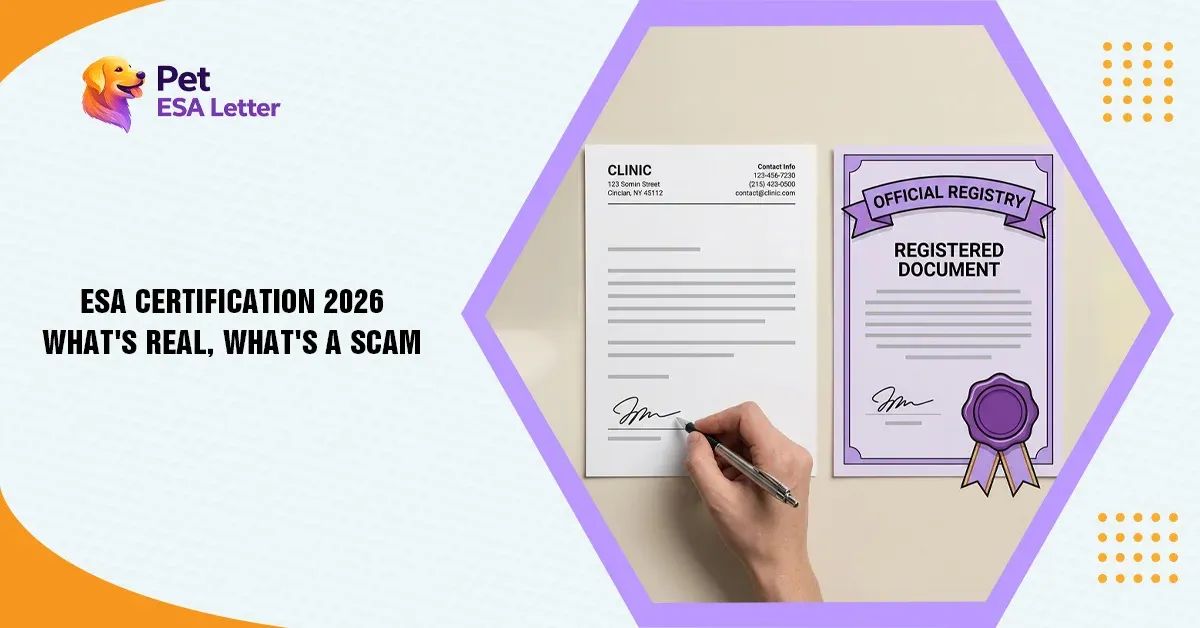
If you’re searching for emotional therapy pet certification, here’s the answer that will save you money: no government agency certifies, registers, or licenses emotional support animals. There’s no federal ESA registry. There’s no card, badge, or certificate that carries legal weight anywhere in the United States.
What actually protects your right to keep an ESA in housing is a letter from a licensed mental health professional. That’s it. Everything else — the vests, the ID cards, the “official registration” — is a product, not a legal requirement.
This matters because websites selling instant certificates have confused millions of pet owners, and some landlords have gotten confused right along with them. We’ll walk you through what’s actually legal, what changed at HUD in 2025 and 2026, what states like California now require, and how to avoid paying for something with zero legal value.
An emotional support animal is a pet that provides comfort to a person with a diagnosed mental or emotional disability, is prescribed by a licensed mental health professional, and is protected under the Fair Housing Act. Unlike service animals, ESAs don’t need any special training. Their presence alone is what helps.
That single sentence covers the entire legal definition. There’s no additional paperwork, class, exam, or vet visit required to make an animal an ESA. The only requirement is a real diagnosis and a real letter from someone licensed to write one — such as a therapist, psychiatrist, psychologist, or licensed clinical social worker.
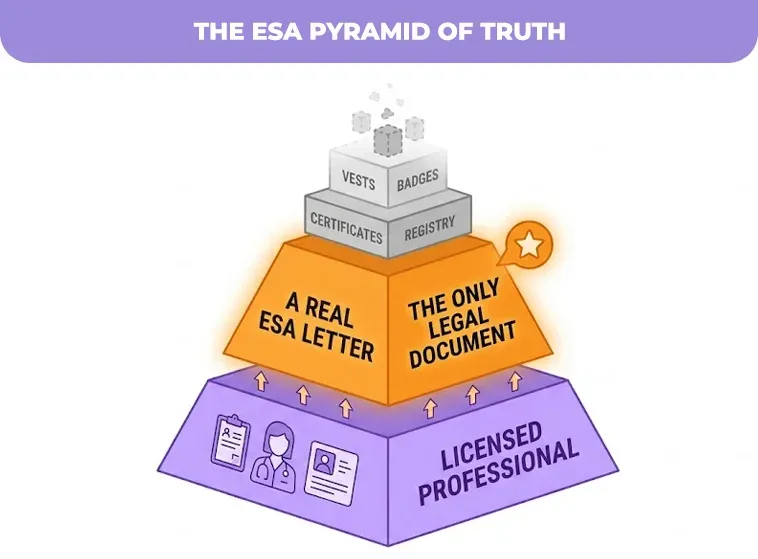
A valid ESA letter must come from a licensed mental health professional, be written on their letterhead, include their license number and type, and state that you have a disability-related need for the animal. Nothing else is legally required, and no certificate or ID card adds to its validity.
Here’s what a legitimate letter includes:
Your name
A statement that you’re under the provider’s care
Confirmation that you have a mental or emotional disability under the FHA’s definition
A statement that the ESA provides support related to that disability
The provider’s license number, license type, and state of licensure
The date and the provider’s signature
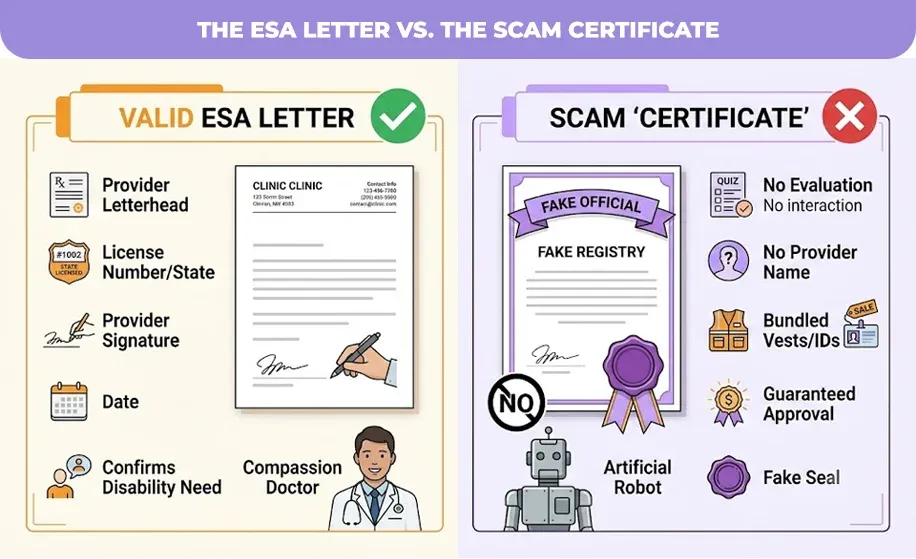
No official ESA registry exists at the federal or state level, and HUD has explicitly stated it does not recognize registration certificates as proof of disability. This is one of the most misunderstood facts in the entire ESA space, and it’s the reason so many people overpay.
Sites that sell registration, a certificate, and a laminated ID card as a bundle are selling three things with no legal function. A landlord who demands to see your ESA registration number is asking for something that doesn’t exist in law — and pushing back on that request, politely, is completely reasonable.
The only document that matters is the letter described above. If a company is selling you a certificate instead of connecting you with a real licensed provider who evaluates you, that’s your first warning sign.
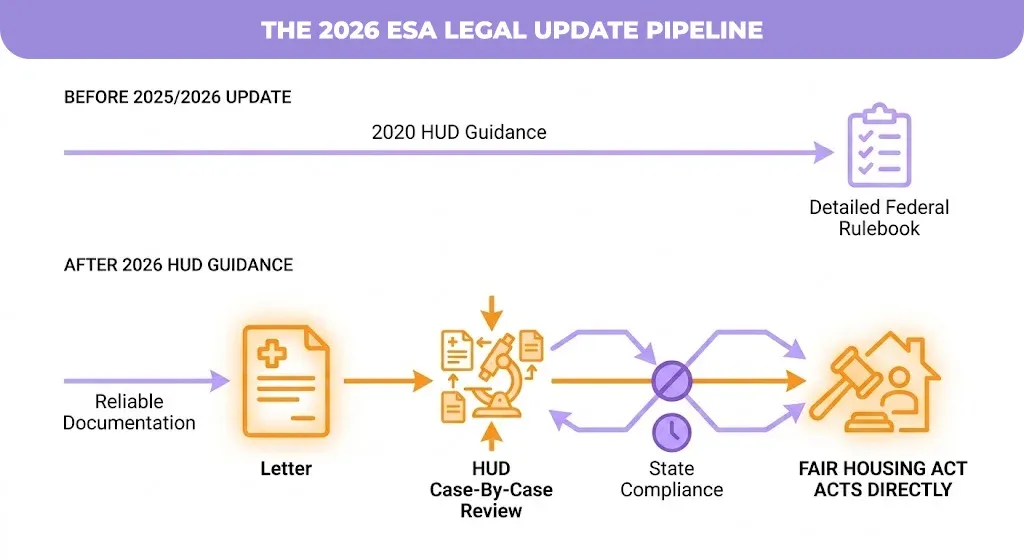
This is the part almost every other article on this topic is missing, and it’s the most important legal update in years. On September 17, 2025, HUD formally withdrew its 2020 guidance on assistance animals (FHEO Notice 2020-01), and on May 22, 2026, HUD made that withdrawal permanent while adopting a narrower enforcement posture toward ESA accommodation claims.
Here’s why this matters. The 2020 guidance was the detailed rulebook landlords and tenants both leaned on — it spelled out exactly what documentation was “reliable,” when housing providers could ask follow-up questions, and how to handle unusual animals. According to Holland & Knight’s legal analysis, the withdrawal was prompted by a February 2025 executive order directing federal agencies to de-prioritize enforcement based on guidance that goes beyond the plain text of a statute.
What this means for you in practice:
The Fair Housing Act itself is unchanged. Landlords still cannot outright refuse a reasonable ESA accommodation for a person with a documented disability.
The detailed federal rulebook is gone. There’s no longer a single HUD document spelling out exactly what “reliable documentation” must contain.
Enforcement is now more case-by-case. According to the National Low Income Housing Coalition, HUD reviews each complaint on its own merits rather than applying the old standardized checklist.
A letter from a real, licensed provider matters more than ever. With less federal guidance to lean on, the strength of your documentation is doing more legal work than it was a year ago.
If you read an article that cites the 2020 HUD notice as current, active guidance, that article is out of date. As of 2026, it’s been officially withdrawn.
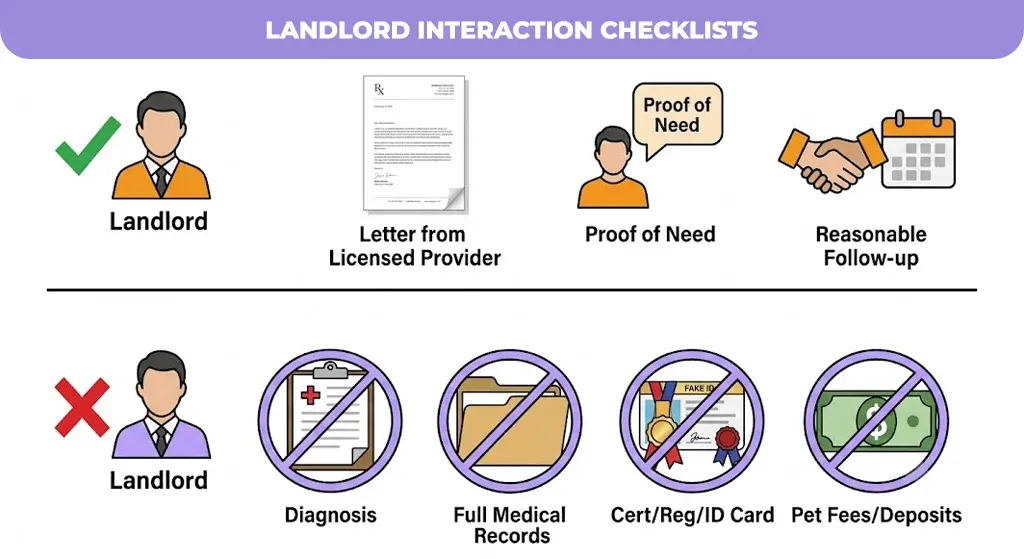
A landlord can ask for a letter confirming your disability-related need but cannot ask for your diagnosis, medical records, or proof of “certification.” Understanding this line protects you from both illegal denials and unnecessary oversharing.
| Landlords CAN Ask | Landlords CANNOT Ask |
|---|---|
| For a letter from a licensed provider | For your specific diagnosis |
| Whether the animal is needed due to a disability | For your full medical or therapy records |
| Reasonable follow-up if the letter is vague | For a certification, registration, or ID card |
| For proof of vaccination/licensing (local law) | To interview your therapist directly |
| To charge for actual property damage | Pet rent, pet deposits, or breed-based fees for the ESA |
If the disability and the need for the animal are already obvious — for example, a guide dog working with a visibly blind handler — a landlord generally cannot ask for documentation at all.
The clearest warning sign of an ESA scam is a company that issues a letter without ever having a real clinician evaluate you. If you can get “approved” from a quiz with no license verification and no follow-up conversation, the letter that comes out of it may not hold up if challenged.
Watch for these red flags:
Instant approval with no clinical evaluation. A real assessment takes more than five multiple-choice questions.
No named, licensed provider on the letter. If you can’t verify a real license number in your state, that’s disqualifying.
Bundled “registration” and ID card upsells. These add no legal protection and often cost more than the letter itself.
Guaranteed approval marketing. No legitimate provider can promise a diagnosis before an evaluation.
No state-specific compliance. In states like California, a legitimate provider must have a client relationship with you for at least 30 days before issuing the letter (AB 468) — a company that skips this is not following the law.
A legitimate ESA letter from a licensed provider typically costs $100 to $200 for a one-time evaluation, sometimes more in states with a required 30-day relationship, since that involves ongoing care rather than a single consultation. Prices vary based on whether you’re seeing a provider for the first time or working with an existing therapist.
There’s no shortcut around the one thing that actually matters: a real letter from a real, licensed mental health professional who has genuinely evaluated your need. Everything sold as “certification” beyond that letter is optional at best and a waste of money at worst.
With HUD’s 2025–2026 guidance changes making documentation quality more important than ever, working with a legitimate, licensed provider — not a certificate mill — is the safest path forward for your housing rights. If you’re ready to talk to a real, licensed provider about your options, PetESALetter can walk you through what a compliant ESA letter looks like for your state.
“Emotional therapy pet certification” is not an official federal certification for emotional support animals (ESAs) in the U.S. An ESA is generally supported by documentation from a licensed mental health professional stating that the person has a disability and needs the animal for support.
No. There is no federal ESA registration or certification that you must obtain. For housing accommodations, what generally matters is reliable documentation supporting the need for an assistance animal when requested by a housing provider.
You generally do not need to purchase a certification. If you believe an ESA would help with a mental or emotional health condition, speak with a licensed mental health professional. If appropriate, they can provide an ESA letter or other documentation supporting your need.
An ESA is not established simply by registering or certifying a pet. Under federal housing rules, an assistance animal can include an animal that provides disability-related emotional support. The animal must also be appropriate for the housing situation and not create a direct threat or significant property damage.
No. The ESA letter is documentation that comes from a qualified professional supporting a person’s need for an emotional support animal. Online registrations, certificates, ID cards, and vests do not replace appropriate professional documentation.
An ESA provides emotional support through its presence and companionship. A service animal is generally a dog individually trained to perform specific tasks that are directly related to a person’s disability. Service animals have different legal protections from emotional support animals.
There is no standard federal expiration date because there is no official ESA certification. An ESA letter may need to be current or updated depending on the housing provider, applicable law, and the professional’s clinical judgment.
Generally, a landlord cannot reject a valid disability-related request simply because an ESA is not registered or certified. However, a housing provider can deny a request in limited circumstances — such as when the accommodation would create an undue burden, fundamentally alter operations, or involve a direct threat or significant property damage.

Licensed Psychotherapist
Darren is a leading expert in mental health advocacy and assistance animal documentation. He specializes in streamlining the process for obtaining ESA Letters, PSD Letters, and State-specific ESA compliance.

ESA Letters Issued

Successful Consultations

Licensed Therapist Network

Client Satisfaction Rate




Petesaletter.com helps you get your emotional support animal letter online with guidance and support.

Got Questions? Call us 24/7
Copyright © 2020-2026 Petesaletter All rights reserved. Terms | Privacy | Refund
Owned and Operated by Verimedix LLC