







ESA LETTER MARYLAND
ESA LETTER MARYLAND — What This Document Actually Means
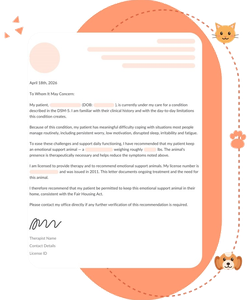
An ESA letter in Maryland is a clinical document from a licensed mental health professional confirming that you have a qualifying condition and that an emotional support animal is part of your treatment. It is not a certificate or registration card.
Without a valid letter, landlords are not required to accommodate your animal. A proper letter gives you enforceable housing rights under federal law.
A legally valid Maryland ESA letter includes the provider’s name, license details, and confirmation of your qualifying condition. Missing information can put your housing protections at risk.


How the Process Works, Step by Step
Four straightforward steps stand between you and a compliant ESA letter. Complete them in one sitting from home, no clinic visits, no waiting rooms.

Fill the Form
Answer a short intake questionnaire about your mental health, daily challenges, and how your animal supports you. Takes about five minutes.

Match With a Therapist
Get connected with a licensed Maryland mental health professional qualified to conduct ESA evaluations and issue legally compliant documentation.

Your Evaluation
The provider reviews your situation through a real clinical consultation. This is where your need for an ESA is professionally assessed not rubber-stamped.

Get Your Letter
If you qualify, your signed Maryland ESA housing letter is delivered digitally, ready to share with your landlord or property manager right away.
Find Out If You Qualify Before You Apply
A licensed mental health professional will evaluate whether an emotional support animal would be a beneficial part of managing your condition. You do not need to already own an animal to qualify. Common conditions that may qualify include:
Maryland ESA Laws You Need to Understand
Maryland follows federal Fair Housing Act protections and does not have a separate state-specific ESA certification law like some other states.
No Registry Required
Maryland does not recognize any official ESA registry. Anyone selling you registration or a vest claiming legal authority is misleading you — the only document that matters is a valid letter from a licensed provider.
Who Can Sign Your Letter
Maryland’s ESA letter requirements are clear: only a licensed mental health professional such as a licensed clinical social worker, psychologist, licensed professional counselor, or psychiatrist, may issue a valid ESA letter.
What the Letter Must Include
A proper Maryland ESA letter must contain the provider's license number, the state of licensure, the type of license, and a statement connecting your condition to the need for an ESA. A sample or template ESA letter found online cannot substitute for this.
Your Landlord's Obligations
Under the FHA, a Maryland landlord receiving a valid ESA request must engage in an interactive process before making any decision. They cannot flatly refuse without legal justification.
No Public Access Rights
An ESA in Maryland does not have the same access rights as a service animal under the ADA. ESA protections apply to housing only — not restaurants, retail stores, or other public places.
Fair Housing Act Protections for Maryland ESA Owners
The Fair Housing Act is the foundation of your ESA housing rights in Maryland. Under the FHA, landlords and housing providers must provide reasonable accommodations for tenants with disabilities. This includes allowing an emotional support animal even when the property has a strict no-pet policy. These protections apply whether you are renting an apartment or a single-family home.
No Pet Fees Allowed
Landlords cannot charge you extra rent, a pet deposit, or a monthly pet fee for a legitimate emotional support animal. An ESA is not legally classified as a pet.
Must Review Your Request
When you submit a valid Maryland ESA housing letter, your landlord is legally required to consider your request and cannot dismiss it outright without engaging in a good-faith review process.
Cannot Ask About Your Diagnosis
Landlords can ask for documentation confirming your need for an ESA, but they are not permitted to demand your full medical records or ask about the specific nature of your condition.
Applies to Most Housing
FHA protections cover most rental housing in Maryland, including those with no-pet clauses with limited exceptions for very small owner-occupied buildings.
Direct Threat to Others
If the specific animal poses a documented and verifiable safety risk to other tenants or causes significant property damage that cannot be reasonably mitigated.
Non-Compliant Documentation
If the letter does not meet legal standards — for example, it was issued without a proper evaluation or lacks the provider's license information.
Undue Financial Hardship
In rare cases where accommodating the ESA creates an extreme and verifiable financial burden on a very small housing provider.
TRAVEL LAWS
Can You Fly With Your ESA in Maryland?
ESA rules for air travel changed in 2021: airlines can now treat emotional support animals as regular pets. Standard pet fees, carrier requirements, and size restrictions apply.
Before flying, check your airline’s current pet policy. A Maryland ESA letter does not guarantee cabin access or special boarding rights.
Your ESA letter mainly protects your housing rights under the Fair Housing Act, which remain fully enforceable.
The Legal Cost of Misusing an ESA Letter
Federal law under the Fair Housing Act prohibits fraudulent ESA claims. While Maryland does not have a standalone ESA fraud statute like some other states, federal misrepresentation and fair housing violations can result in serious legal exposure for both the person submitting the false claim and any provider who issues documentation improperly.
Legal Consequences for Improper ESA Use:
WHY US
Why Maryland Residents Trust Us With Their ESA Documentation
Fully FHA Compliant
Every letter we issue meets federal Fair Housing Act standards, so your housing request stands on solid legal ground from day one.
Licensed Maryland Providers
You are evaluated by licensed mental health professionals authorized to practice in Maryland not out-of-state providers operating in legal gray areas.
Real Clinical Evaluations
We do not sell instant approvals. Every ESA letter follows a genuine clinical consultation that meets the standards landlords and property managers expect.
Fast Digital Delivery
Once approved, your letter reaches you digitally — no printing, no mailing, no waiting a week to get started on your housing request.
Landlord Verification Ready
Our letters include all required provider information so landlords can verify authenticity quickly, reducing delays in your approval process.
Clear, Honest Pricing
You see exactly what you pay upfront. No surprise charges, no upsells disguised as requirements, and no hidden renewal fees buried in fine print.
Dedicated Support Team
Have questions before, during, or after your evaluation? Our support team is available to help you through every step of the process.
Privacy-First Platform
Your health information is handled with strict HIPAA-compliant confidentiality. Your data stays yours — we never share it without your consent.
TESTIMONIALS
What Maryland Residents Are Saying
I spoke with the therapist and he took time to actually understand my situation. It felt like more than a real talk and I was so satisfied with the process.
FAQs
Answers to Common Questions
Licensed mental health professionals, such as psychologists, psychiatrists, licensed counselors, and clinical social workers, can write ESA letters after properly evaluating you.
Yes. An emotional support animal can help some people with bipolar disorder by providing comfort, routine, and companionship — though it is not a substitute for medical treatment.
Yes. Maryland recognizes emotional support animals under federal fair housing law, which requires landlords to make reasonable accommodations for qualified individuals.
Yes. A licensed physician (MD) can issue an ESA letter if they are treating you and can professionally assess your need for the animal.
Generally, no. However, they may deny an ESA if the animal poses a direct threat, causes significant property damage, or if the housing falls under certain legal exemptions.
Yes. Many apartments verify ESA letters by checking the provider's credentials and ensuring the documentation meets Fair Housing Act requirements.